
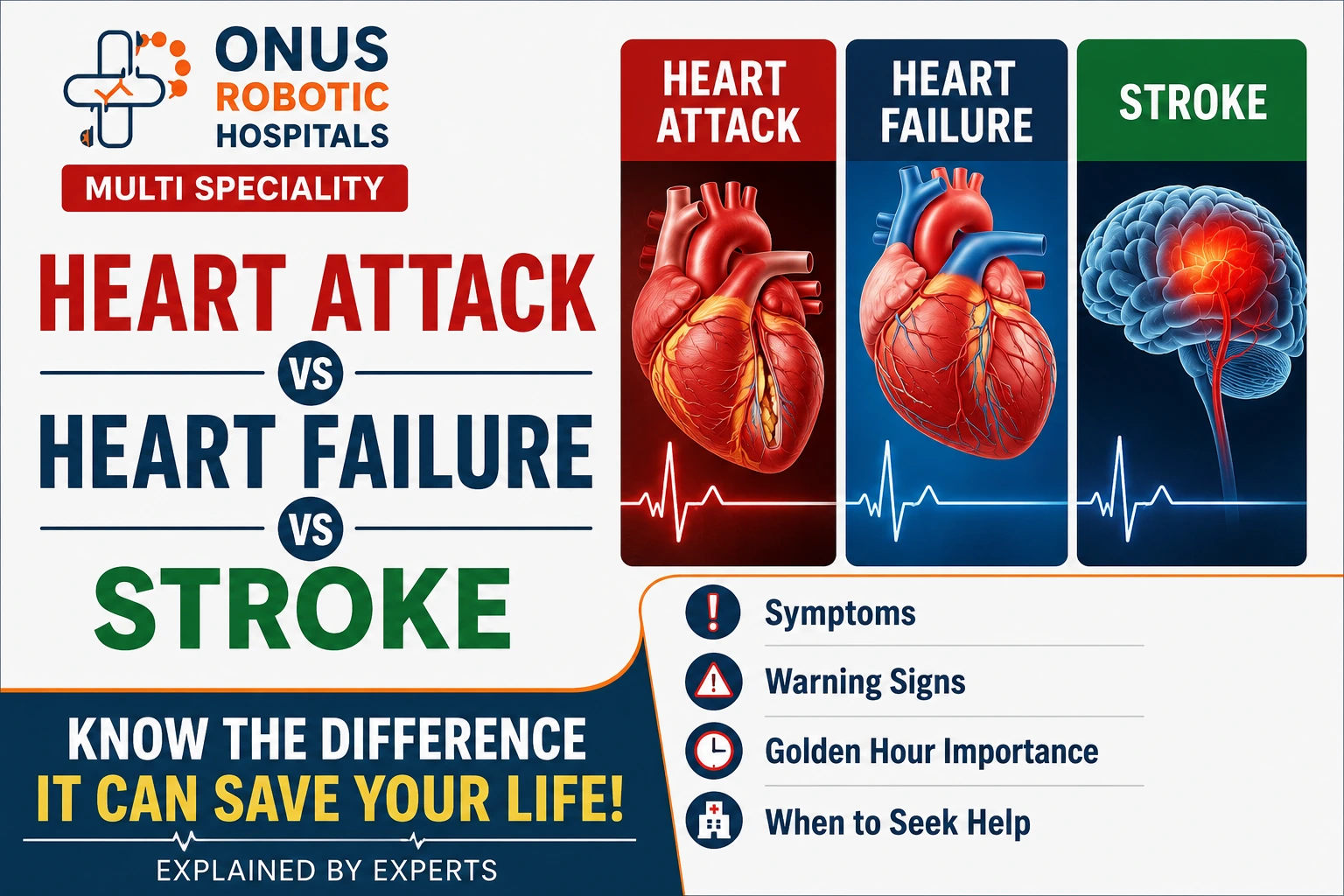
Heart Attack vs Heart Failure vs Stroke: Understanding the Difference Can Save a Life – By Dr. Ravi Kiran | Diabetologist, Onus Robotic Hospital
Introduction
Heart Attack, Heart Failure, and Stroke are among the leading causes of medical emergencies worldwide. Although these conditions affect different organs and occur for different reasons, they are often confused with one another. Unfortunately, this confusion can delay treatment, leading to permanent disability or even death.
Recognizing the warning signs and seeking immediate medical attention during the Golden Hour can significantly improve survival and recovery.
In this article, Dr. P. Ravi Kiran, Consultant Cardiologist at ONUS Robotic Hospitals, explains the differences between these three life-threatening conditions, their symptoms, causes, and when to seek emergency care.
What is a Heart Attack?
A Heart Attack (Myocardial Infarction) occurs when one or more arteries supplying blood to the heart become blocked. The blockage is usually caused by a blood clot forming over cholesterol deposits (plaque).
Without oxygen-rich blood, the heart muscle begins to die.
Common Causes
- Blocked coronary arteries
- High cholesterol
- Diabetes
- High blood pressure
- Smoking
- Obesity
- Family history
- Stress
- Lack of physical activity
Symptoms of Heart Attack
- Severe chest pain or pressure
- Pain spreading to the left arm, shoulder, neck, jaw, or back
- Shortness of breath
- Cold sweating
- Nausea or vomiting
- Dizziness
- Fatigue
Some patients, especially women and diabetics, may experience mild symptoms or no chest pain at all.
What is Heart Failure?
Heart Failure does not mean the heart has stopped working. It means the heart has become weak and cannot pump enough blood to meet the body’s needs.
Heart failure usually develops gradually after years of damage caused by high blood pressure, previous heart attacks, valve disease, or cardiomyopathy.
Common Causes
- Previous heart attack
- Long-standing hypertension
- Heart valve disorders
- Cardiomyopathy
- Diabetes
- Kidney disease
Symptoms of Heart Failure
- Breathlessness during activity or while lying down
- Swelling in feet, ankles, and legs
- Fatigue
- Persistent cough
- Rapid heartbeat
- Difficulty exercising
- Sudden weight gain due to fluid retention
Heart failure requires lifelong treatment and regular follow-up to prevent worsening.
What is a Stroke?
A Stroke occurs when blood flow to the brain is interrupted or when a blood vessel inside the brain bursts.
Without oxygen, brain cells begin to die within minutes.
There are two major types:
Ischemic Stroke
Caused by blockage of a blood vessel supplying the brain.
Hemorrhagic Stroke
Caused by bleeding inside the brain due to rupture of a blood vessel.
Warning Signs of Stroke (Remember FAST)
F – Face Drooping
One side of the face suddenly droops.
A – Arm Weakness
Difficulty lifting one arm or leg.
S – Speech Difficulty
Slurred speech or inability to speak clearly.
T – Time to Call Emergency Services
Immediate treatment is essential.
Other symptoms include:
- Sudden confusion
- Loss of balance
- Severe headache
- Vision changes
- Sudden dizziness
- Weakness on one side of the body
Heart Attack vs Heart Failure vs Stroke
| Condition | Heart Attack | Heart Failure | Stroke |
|---|---|---|---|
| Affected Organ | Heart | Heart | Brain |
| Main Cause | Blocked blood supply | Weak pumping function | Blocked artery or brain bleeding |
| Onset | Sudden | Usually gradual | Sudden |
| Major Symptoms | Chest pain, sweating | Breathlessness, swelling | Weakness, speech difficulty |
| Emergency | Yes | Can become emergency | Yes |
| Immediate Treatment Needed | Yes | Yes (if severe) | Yes |
📍 Dr. Ravi Kiran
Diabetologist & Preventive Medicine Specialist
Onus Robotic Hospital, Hyderabad
