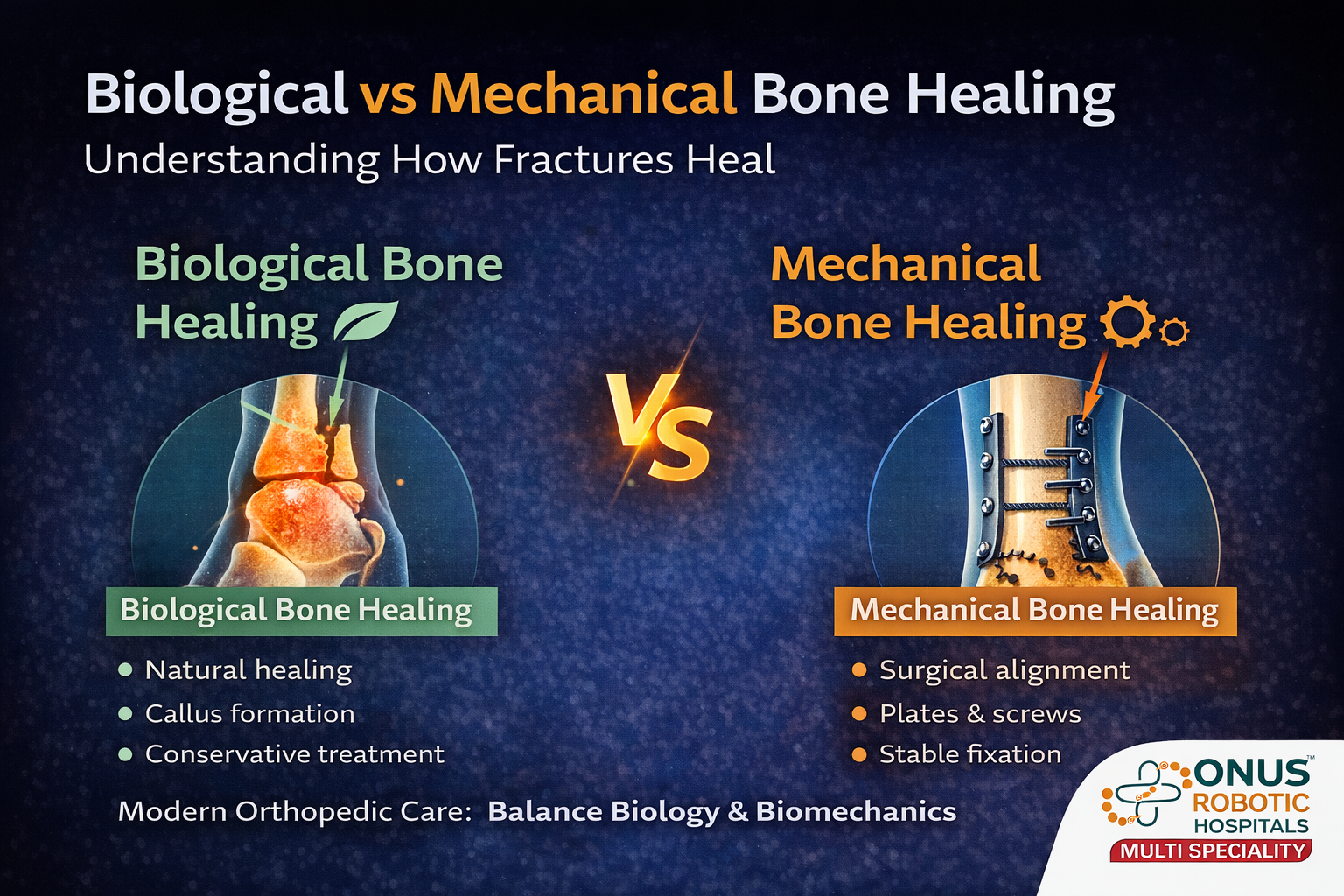
🦴 Biological vs Mechanical Bone Healing – Understanding How Fractures Heal: By Dr. Balaraju Naidu, Robotic Orthopedic Surgeon, ONUS Robotic Hospitals
Bone healing is one of the body’s most fascinating natural processes. Unlike many tissues, bone has the ability to regenerate and restore its original structure. However, not all fractures heal in the same way.
Depending on the type of fracture, stability, blood supply, age, and treatment method, bones heal through either biological healing or mechanical healing — or sometimes a combination of both.
Understanding this difference helps patients set realistic expectations and choose the most appropriate treatment.
🌱 Biological Bone Healing (Natural Healing)
Biological bone healing relies on the body’s natural repair mechanisms. It occurs when the fracture environment allows controlled movement and preserves blood supply.
🔬 How It Works
After a fracture:
-
Blood clot forms at the fracture site
-
Soft callus develops
-
Hard callus bridges the fracture
-
Bone remodels over time
This process creates visible callus on X-rays and gradually restores strength.
✅ Best Suited For
-
Non-displaced fractures
-
Stable fractures
-
Children and young adults
-
Good bone quality
-
Fractures treated with casts or braces
⭐ Advantages
-
Preserves natural bone biology
-
No surgical risks
-
Lower cost
-
Ideal for growing bones
⚠️ Limitation: Excessive movement can delay healing or cause non-union.
⚙️ Mechanical Bone Healing (Surgical Healing)
Mechanical bone healing depends on absolute stability, usually achieved through surgery.
🔧 How It Works
-
Plates, screws, rods, or nails hold the bone fragments firmly
-
Minimal movement allows direct bone healing
-
Little or no callus formation is seen
✅ Best Suited For
-
Displaced fractures
-
Joint surface fractures
-
Elderly patients
-
Polytrauma cases
-
Fractures affecting alignment or limb function
⭐ Advantages
-
Accurate alignment
-
Faster functional recovery
-
Reduced deformity risk
-
Early mobilization
⚠️ Limitation: Surgery involves risks like infection and soft tissue injury if not done precisely.
🆚 Key Differences at a Glance
| Feature | Biological Healing | Mechanical Healing |
|---|---|---|
| Stability | Relative | Absolute |
| Callus formation | Yes | Minimal / None |
| Treatment | Cast / Brace | Plates / Screws / Rods |
| Blood supply | Fully preserved | Partially affected |
| Best for | Stable fractures | Unstable / joint fractures |
| Recovery focus | Natural repair | Precision alignment |
🏥 Modern Orthopedic Approach: Best of Both Worlds
Today’s orthopedic care focuses on balancing biology and biomechanics.
Modern techniques aim to:
-
✔ Preserve blood supply
-
✔ Minimize soft tissue damage
-
✔ Provide adequate stability
-
✔ Enable early rehabilitation
🤖 Robotic-assisted and minimally invasive fracture surgeries allow precise fixation while protecting bone biology — resulting in faster healing and fewer complications.
🔑 Final Takeaway
Successful fracture healing is not about choosing surgery or non-surgery blindly.
It’s about choosing the right healing environment for each fracture.
🦴 Biology heals the bone.
⚙️ Mechanics guide the bone.
⚖️ Balance ensures the best outcome.
Always consult an orthopedic specialist to decide the most suitable healing strategy for your fracture.
For Appointments:
Dr. Balaraju Naidu, Robotic Orthopedic Surgeon
ONUS Robotic Hospitals – Hyderabad
👉 Button link: contact-us or book-appointment
✅ Hashtags
#BoneHealing
#FractureCare
#OrthopedicEducation
#BiologicalHealing
#MechanicalHealing
#FractureTreatment
#RoboticOrthopedics
#BoneHealth
#MedicalAwareness