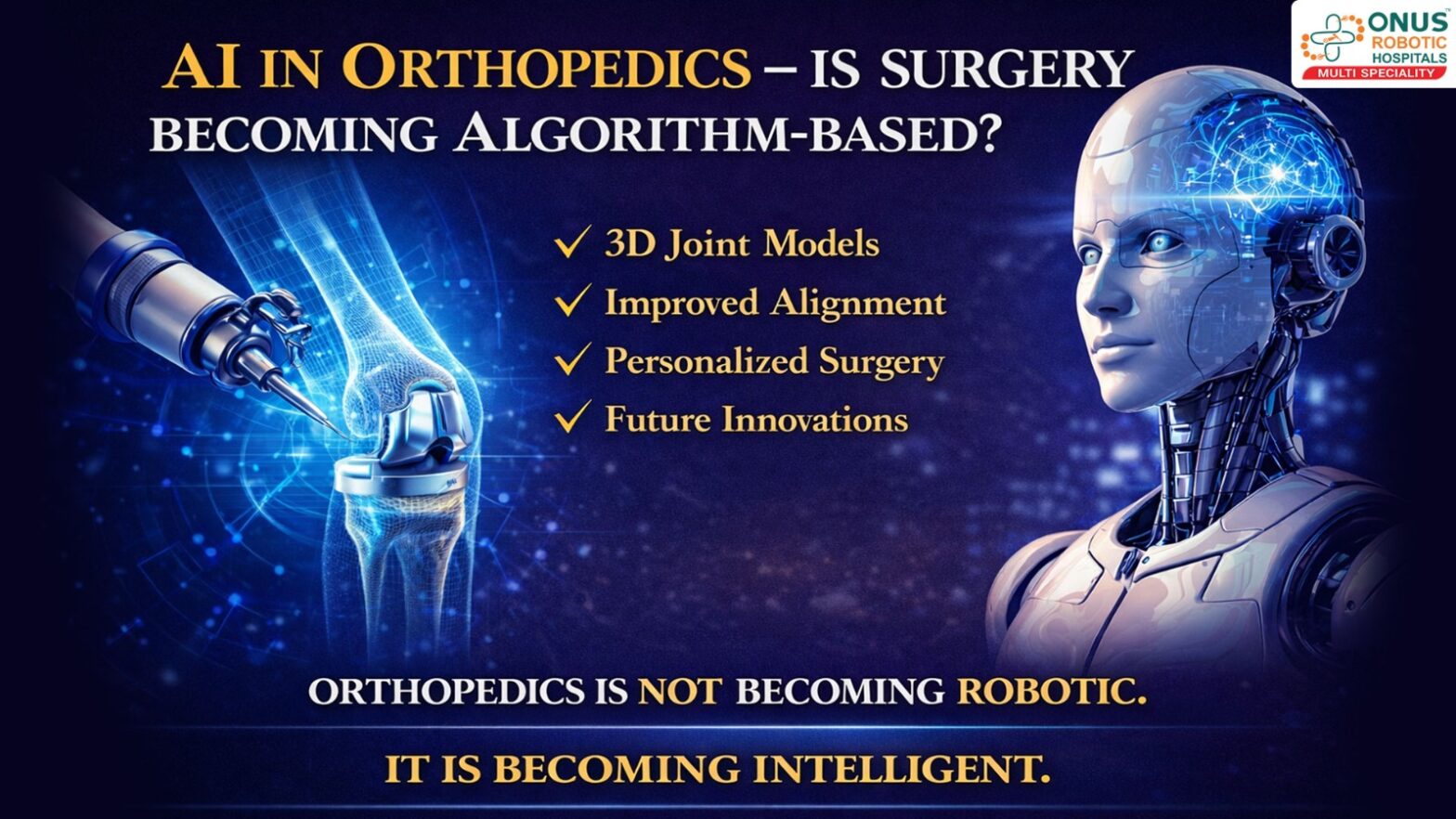
AI in Orthopedics – Is Surgery Becoming Algorithm-Based? – By Dr. Balaraju Naidu, Robotic Orthopedic Surgeon, ONUS Robotic Hospitals
Orthopedic surgery is undergoing one of the most significant technological transformations in modern medicine. Artificial Intelligence (AI), robotics, data analytics, and machine learning are now integrated into joint replacement, fracture planning, and post-operative rehabilitation.
But an important question arises:
Is surgery becoming algorithm-based?
Is the surgeon being replaced by machines?
The answer is clear:
AI enhances surgical intelligence — it does not replace human expertise.
What Is Artificial Intelligence in Orthopedics?
Artificial Intelligence in orthopedics refers to software systems that analyze large medical datasets and imaging studies to assist surgeons in planning and executing procedures with higher precision.
These systems process:
-
CT scans
-
MRI imaging
-
X-rays
-
Biomechanical data
-
Patient-specific anatomical variations
Using this data, AI generates:
-
3D joint reconstruction models
-
Implant size recommendations
-
Alignment planning
-
Ligament balance simulation
-
Bone resection mapping
This reduces surgical variability and improves reproducibility.
What Does AI Actually Do During Surgery?
In robotic-assisted orthopedic procedures, AI helps in:
1️⃣ Pre-Operative Planning
-
Creates detailed 3D joint models
-
Calculates mechanical alignment
-
Suggests ideal implant positioning
2️⃣ Intra-Operative Guidance
-
Tracks instrument position in real time
-
Prevents excessive bone cuts
-
Provides ligament tension feedback
3️⃣ Post-Operative Optimization
-
Analyzes outcomes
-
Helps refine future surgical planning
AI acts as a highly advanced navigation assistant.
Does AI Replace the Orthopedic Surgeon?
Absolutely not.
AI:
✔ Provides recommendations
✔ Improves precision
✔ Reduces human error
But:
❌ It does not perform surgery independently
❌ It does not make clinical judgments
❌ It cannot handle unexpected complications
The surgeon:
-
Makes all final decisions
-
Controls the robotic arm
-
Manages intra-operative challenges
-
Takes responsibility for patient outcomes
AI enhances expertise — it does not substitute it.
Benefits of AI-Based Orthopedic Surgery
✔ Improved Alignment Accuracy
Precise implant positioning reduces wear and improves longevity.
✔ Reduced Revision Rates
Better planning lowers the risk of early implant failure.
✔ Faster Rehabilitation
Accurate soft tissue balancing reduces pain and swelling.
✔ Personalized Treatment Planning
Each surgery is tailored to individual anatomy.
✔ Better Implant Longevity
Proper alignment directly impacts durability.
Are There Risks with AI in Surgery?
Like any advanced technology, AI systems depend on:
-
Accurate imaging quality
-
Proper machine calibration
-
Surgeon expertise
-
Institutional experience
Technology without training does not guarantee success.
AI is a tool — outcomes depend on how well it is used.
The Future of AI in Orthopedics
The next decade may introduce:
🔹 Smart implants with embedded sensors
🔹 Predictive arthritis progression models
🔹 AI-guided physiotherapy programs
🔹 Automated outcome tracking
🔹 Real-time remote surgical analytics
Orthopedics is not becoming robotic.
It is becoming intelligent, data-driven, and personalized.
Final Thought
Surgery is not becoming algorithm-based.
It is becoming precision-based.
Technology does not replace surgeons.
It empowers them.
The future of orthopedics lies in combining:
Human judgment + Machine precision + Data intelligence
For Appointments:
Dr. Balaraju Naidu, Robotic Orthopedic Surgeon
ONUS Robotic Hospitals – Hyderabad
👉 link: contact-us or book-appointment