Introduction
Knee arthritis is one of the leading causes of pain, stiffness, and reduced mobility among adults, particularly in older age groups. When medications, physiotherapy, injections, and lifestyle modifications no longer provide relief, knee replacement surgery becomes an effective treatment option.
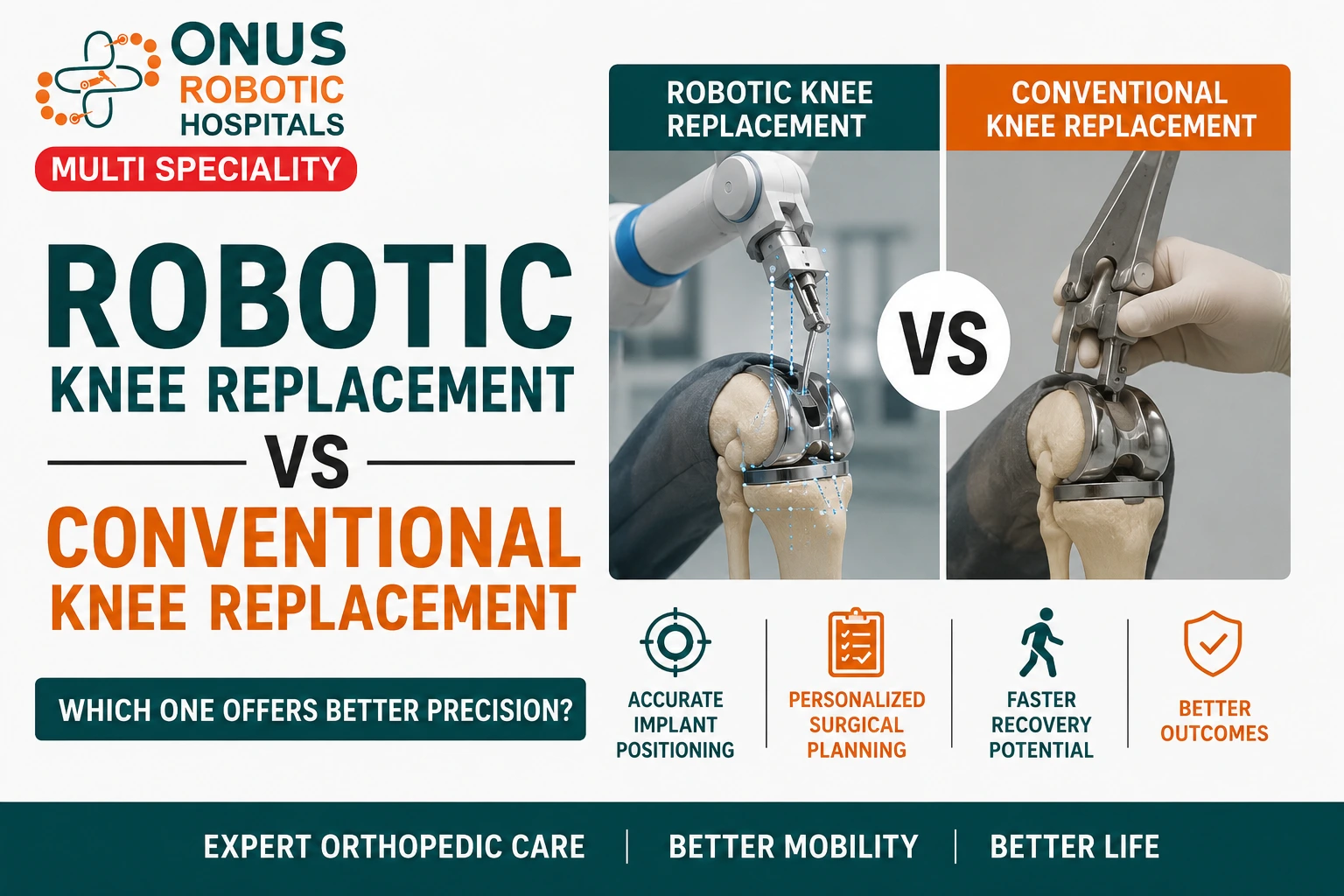
With advancements in orthopedic technology, patients now have access to Robotic Knee Replacement Surgery, a modern approach that enhances precision and personalization during joint replacement procedures.
Many patients often ask:
“What is the difference between Robotic Knee Replacement and Conventional Knee Replacement?”
Understanding the differences can help patients make informed decisions about their treatment and recovery.
What Is Knee Replacement Surgery?
Knee replacement surgery, also known as Total Knee Arthroplasty (TKA), involves removing damaged cartilage and bone from the knee joint and replacing them with artificial implants.
The goals of surgery are to:
- Relieve pain
- Restore movement
- Improve knee function
- Enhance quality of life
Both robotic and conventional techniques aim to achieve these outcomes, but the way the surgery is performed differs significantly.
What Is Conventional Knee Replacement Surgery?
In conventional knee replacement surgery, orthopedic surgeons use standard surgical instruments and manual techniques to align and position the knee implant.
The surgeon relies on:
- Preoperative X-rays
- Surgical experience
- Mechanical alignment guides
While conventional knee replacement has been successfully performed for decades, the accuracy of implant positioning largely depends on the surgeon’s expertise and anatomical variations among patients.
What Is Robotic Knee Replacement Surgery?
Robotic Knee Replacement Surgery combines the expertise of the surgeon with advanced robotic technology.
The robotic system does not perform the surgery independently. Instead, it assists the surgeon by providing:
- Detailed 3D planning
- Real-time surgical guidance
- Precise bone preparation
- Accurate implant positioning
The surgeon remains in complete control throughout the procedure.
Key Differences Between Robotic and Conventional Knee Replacement
1. Surgical Planning
Conventional Surgery
Planning is based primarily on X-rays and standard measurements.
Robotic Surgery
Advanced imaging creates a patient-specific 3D model of the knee, allowing individualized surgical planning.
2. Implant Positioning Accuracy
Conventional Surgery
Alignment depends on manual instruments and surgeon judgment.
Robotic Surgery
Robotic technology helps achieve highly precise implant placement with real-time guidance.
More accurate positioning may improve implant performance and longevity.
3. Bone Preservation
Conventional Surgery
Bone cuts are made using standard guides.
Robotic Surgery
The robotic system allows highly controlled bone preparation, helping preserve healthy bone and soft tissue.
4. Soft Tissue Balancing
Proper balancing of ligaments is essential for smooth knee movement.
Conventional Surgery
Soft tissue balancing is performed manually.
Robotic Surgery
The robotic platform provides detailed information regarding ligament tension and joint balance throughout the procedure.
5. Personalization
Conventional Surgery
Standardized techniques are used for most patients.
Robotic Surgery
Each procedure is customized according to the patient’s unique anatomy.
6. Recovery Experience
Many patients undergoing robotic knee replacement report:
- Reduced postoperative pain
- Improved early mobility
- Shorter hospital stay
- Faster rehabilitation
However, recovery varies from patient to patient.
Advantages of Robotic Knee Replacement Surgery
Greater Precision
Robotic systems allow surgeons to perform bone cuts with sub-millimeter accuracy.
Improved Implant Alignment
Proper implant positioning may contribute to:
- Better knee function
- Improved joint mechanics
- Enhanced implant longevity
Reduced Soft Tissue Trauma
Precise planning can minimize unnecessary disruption to surrounding tissues.
Better Functional Outcomes
Many patients experience:
- Improved walking ability
- Better range of motion
- Increased confidence during movement
Enhanced Patient Satisfaction
Studies suggest higher satisfaction rates among many robotic knee replacement patients.
Benefits of Conventional Knee Replacement Surgery
Conventional knee replacement remains a highly successful procedure and continues to provide excellent results for millions of patients worldwide.
Benefits include:
- Proven long-term outcomes
- Widely available technology
- Effective pain relief
- Excellent durability when performed by experienced surgeons
Who Is a Good Candidate for Robotic Knee Replacement?
Robotic-assisted knee replacement may be suitable for patients with:
- Severe knee osteoarthritis
- Rheumatoid arthritis
- Knee deformities
- Persistent knee pain affecting daily activities
- Failed conservative treatments
A thorough orthopedic evaluation is necessary to determine suitability.
Does the Robot Perform the Surgery?
One of the biggest misconceptions is that the robot performs the operation independently.
In reality:
- The surgeon performs the surgery.
- The robotic system assists with planning and precision.
- The surgeon controls every step of the procedure.
Robotic technology enhances surgical accuracy but does not replace the expertise of the orthopedic surgeon.
Recovery After Knee Replacement Surgery
Whether robotic or conventional, recovery typically involves:
Early Mobilization
Walking usually begins within 24 hours after surgery.
Physiotherapy
Structured rehabilitation helps restore:
- Strength
- Flexibility
- Range of motion
Pain Management
Modern pain-control protocols improve comfort during recovery.
Return to Daily Activities
Most patients gradually resume normal activities over several weeks to months.
Is Robotic Knee Replacement Worth It?
For many patients, robotic-assisted knee replacement offers significant advantages through enhanced precision and individualized planning.
Potential benefits include:
- Better implant alignment
- Improved knee mechanics
- Faster recovery
- Greater patient satisfaction
However, both robotic and conventional knee replacement surgeries can produce excellent outcomes when performed by experienced orthopedic surgeons.
For Appointments:
Dr. Balaraju Naidu, Robotic Orthopedic Surgeon
ONUS Robotic Hospitals – Hyderabad
👉 link: contact-us or book-appointment