Why Some Fractures Need Surgery Even If They Look Minor: By Dr. Balaraju Naidu, Robotic Orthopedic Surgeon, ONUS Robotic Hospitals
When people hear the word fracture, they often imagine a visibly broken or severely deformed bone that clearly requires surgery. In reality, the decision to operate is not based on how dramatic a fracture looks, but on how it behaves, where it is located, and what risks it poses if left untreated.
Many fractures that appear “small” or “minor” on X-rays can still cause long-term pain, deformity, arthritis, or functional loss if managed incorrectly. Understanding why some seemingly simple fractures require surgery helps patients make informed decisions and avoid complications.
🔍 Why Appearance Alone Can Be Misleading
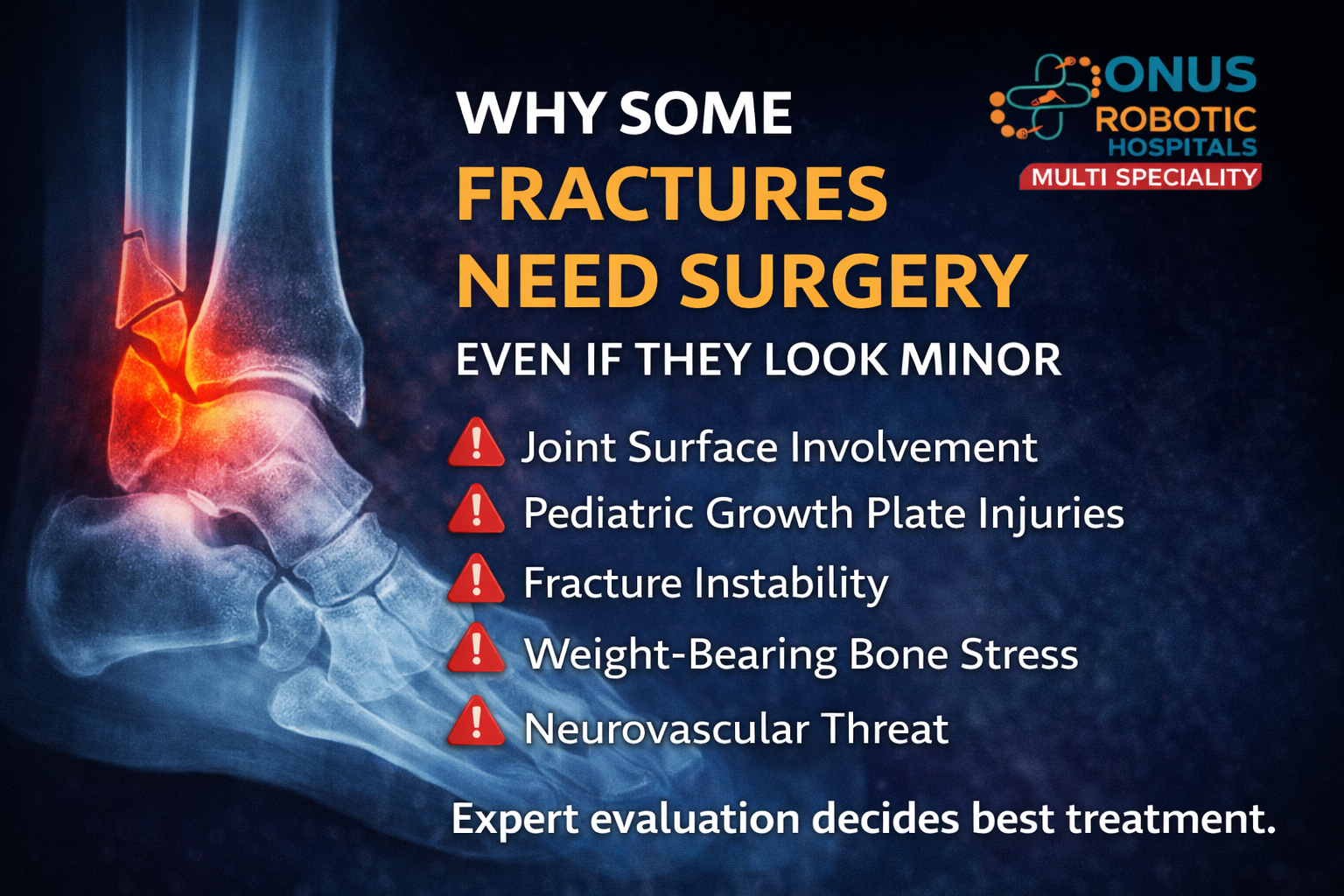
X-rays show bone alignment at one moment in time. They do not always reveal instability, joint surface damage, growth plate involvement, or neurovascular risk. What looks acceptable initially may worsen over days or weeks.
Orthopedic treatment focuses on:
-
Long-term joint function
-
Bone healing quality
-
Prevention of arthritis and deformity
-
Preservation of nerves, vessels, and growth potential
🔑 Key Reasons Minor-Looking Fractures May Need Surgery
1️⃣ Joint Surface Involvement (Intra-Articular Fractures)
When a fracture extends into a joint—even slightly—it can disrupt the smooth cartilage surface.
Why surgery matters:
-
Even 1–2 mm of joint misalignment can lead to early arthritis
-
Causes stiffness, pain, and reduced mobility
-
Poor outcomes if not anatomically realigned
👉 Surgical fixation restores joint congruity and prevents long-term damage.
2️⃣ Pediatric Growth Plate (Physeal) Injuries
In children, fractures near joints often involve the growth plate, which controls bone length and shape.
If untreated:
-
Unequal limb length
-
Angular deformities
-
Permanent functional issues
👉 Surgery may be required to precisely realign and protect future growth.
3️⃣ Fracture Instability (Even If Initially Aligned)
Some fractures look well-aligned initially but are biomechanically unstable.
Risks of non-surgical treatment:
-
Gradual shifting inside the cast
-
Malunion (healing in the wrong position)
-
Need for complex corrective surgery later
👉 Surgical stabilization prevents secondary displacement.
4️⃣ Weight-Bearing Bone Stress
Fractures in bones that carry body weight—such as the hip, knee, ankle, or heel—face continuous stress.
Why surgery is often needed:
-
Minor cracks can collapse under load
-
Alters walking mechanics
-
Leads to chronic pain and arthritis
👉 Fixation ensures early mobility and proper healing.
5️⃣ Risk to Nerves and Blood Vessels
Some fractures lie close to critical nerves or blood vessels.
Delayed treatment may cause:
-
Permanent nerve damage (weakness, numbness)
-
Vascular compromise
-
Limb-threatening complications
👉 Early surgical intervention protects vital structures.
🤖 Role of Robotic & Minimally Invasive Orthopedic Surgery
Modern orthopedic care has evolved far beyond traditional open surgery.
Advantages include:
-
🎯 Precise alignment and fixation
-
🩹 Minimal soft-tissue damage
-
⚡ Faster recovery and reduced pain
-
🦴 Better bone healing and long-term joint function
Robotic assistance allows surgeons to plan and execute fracture fixation with exceptional accuracy.
⚠️ Why Delaying Surgery Can Be Harmful
Postponing recommended surgical treatment may result in:
-
Improper bone healing
-
Chronic pain and stiffness
-
Early arthritis
-
Reduced strength and mobility
-
More complex revision surgeries
What could have been a simple, precise procedure may turn into a challenging reconstruction later.
✅ Key Takeaway
🔹 Never judge a fracture by its size or appearance alone
🔹 Treatment decisions depend on stability, location, joint involvement, and long-term impact
🔹 Early expert evaluation ensures the best outcome
📍 Consult ONUS Robotic Hospitals
Advanced orthopedic care with robotic precision, minimally invasive techniques, and expert fracture management—designed to restore function, prevent complications, and protect your future mobility.
If you or a loved one has sustained a fracture, don’t assume it’s minor. Get it evaluated by an orthopedic specialist who looks beyond the X-ray and plans for lifelong joint health.
For Appointments:
Dr. Balaraju Naidu, Robotic Orthopedic Surgeon
ONUS Robotic Hospitals – Hyderabad
👉 Button link: contact-us or book-appointment
✅ Hashtags
#FractureCare
#OrthopedicAwareness
#BoneHealth
#FractureTreatment
#RoboticOrthopedics
#MinimallyInvasiveSurgery
#JointHealth
#InjuryCare
#OrthopedicSurgery
#ONUSRoboticHospitals