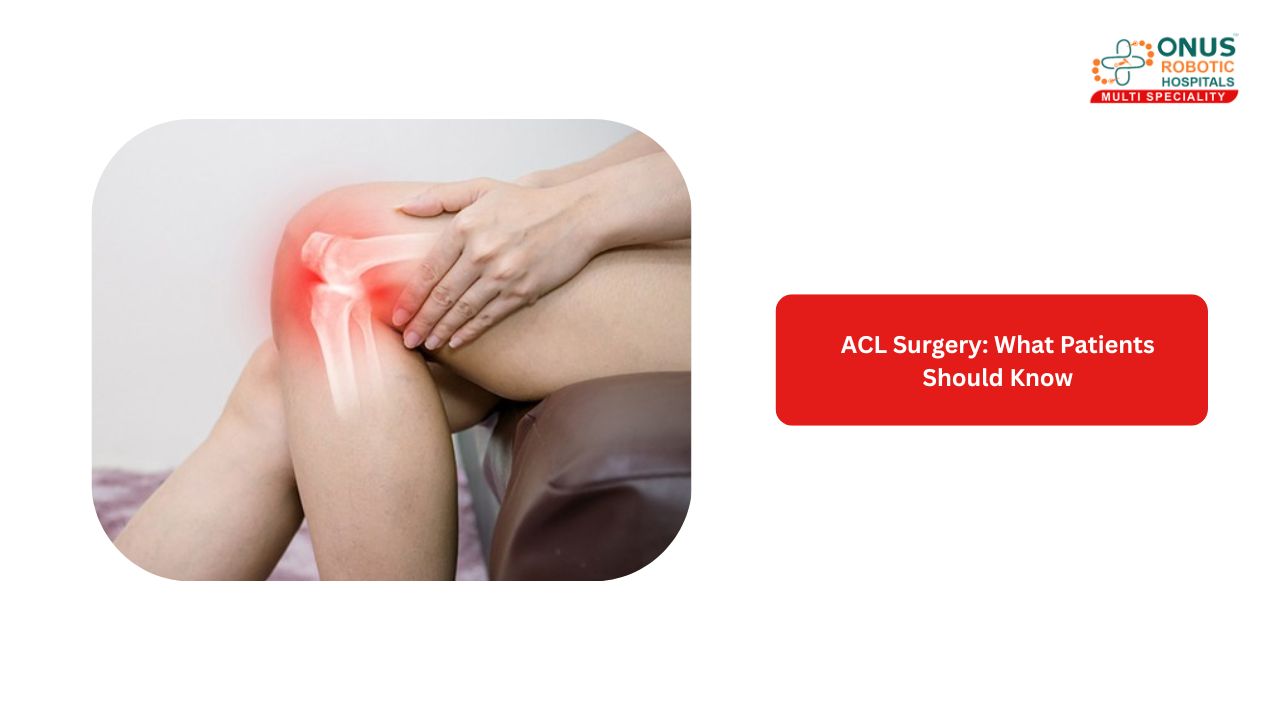
ACL Surgery: What Patients Should Know- By Dr. K. Sai Prajwal Reddy, Consultant Arthroscopy, ONUS Robotic Hospitals
Complete Guide to ACL Tear, Treatment Options, Surgery & Recovery
If you’ve injured your knee and been told you have an ACL Tear, it’s natural to feel concerned. The good news is that with the right treatment and rehabilitation, most patients recover well and return to their normal activities—even sports.
At ONUS Robotic Hospitals, ACL injuries are managed with advanced techniques by specialists like Dr. K. Sai Prajwal Reddy, focusing on restoring knee stability and long-term joint health.
What Is the ACL and Why Is It Important?
The Anterior Cruciate Ligament (ACL) is one of the key ligaments in the knee joint.
Its Role:
- Stabilizes the knee
- Prevents the shin bone from moving forward
- Supports movements like:
- Running
- Pivoting
- Jumping
- Sudden direction changes
👉 When the ACL tears, the knee loses stability.
Common Symptoms of an ACL Tear
You may suspect an ACL injury if you experience:
- Sudden “pop” sound during injury
- Immediate swelling
- Knee pain
- Feeling of instability
- Knee “giving way” while walking
- Difficulty bearing weight
👉 These symptoms require early evaluation.
Do All ACL Tears Need Surgery?
No. Treatment depends on activity level and knee stability.
Non-Surgical Treatment May Work If:
- You are less active
- Knee feels stable
- No major associated injuries
Surgery Is Recommended If:
- You are young and active
- You play sports or want to return to sports
- Knee keeps giving way
- Associated meniscus injury is present
- Physiotherapy alone is not enough
👉 For active individuals, surgery offers better long-term stability.
What Is ACL Surgery?
ACL Reconstruction is the standard treatment.
Key Points:
- Minimally invasive (keyhole surgery)
- Done using arthroscopy
- Small cuts, faster recovery
What Happens During ACL Surgery?
Step-by-Step Overview
- Arthroscope (camera) inserted into knee
- Torn ACL is removed
- New ligament (graft) is placed
- Graft is fixed with special implants
Types of Grafts
- Hamstring tendon graft
- Patellar tendon graft
- Donor graft (in selected cases)
👉 The graft acts like a new ligament.
Recovery After ACL Surgery
Recovery is gradual and requires commitment.
Early Phase (0–6 Weeks)
- Pain and swelling control
- Gentle exercises
- Walking with support
Intermediate Phase (6–12 Weeks)
- Muscle strengthening
- Improved range of motion
- Balance training
Advanced Phase (3–6 Months)
- Sport-specific exercises
- Agility training
Return to Sports
- Usually after 6–9 months
- Only after medical clearance
👉 Physiotherapy is the most important part of recovery.
Benefits of ACL Surgery
ACL reconstruction helps you:
- Regain knee stability
- Return to sports and activities
- Prevent repeated injuries
- Protect cartilage and meniscus
- Improve confidence in movement
Risks of ACL Surgery
Like any surgery, there are some risks:
- Infection
- Knee stiffness
- Swelling
- Graft failure
- Delayed recovery
👉 These risks are low with proper care and rehab.
What Happens If ACL Tear Is Left Untreated?
Ignoring an ACL tear can lead to:
- Repeated knee instability
- Meniscus damage
- Early arthritis
- Reduced activity levels
👉 Early treatment protects long-term knee health.
When Should You See a Doctor?
Consult an orthopedic specialist if:
- You had a twisting knee injury
- Heard a “pop” sound
- Knee swelled quickly
- Knee feels unstable
- Difficulty walking or running
👉 Early diagnosis helps plan the best treatment.
Final Takeaway
ACL injuries are common—but highly treatable.
The right decision (surgery vs rehab) depends on your lifestyle and goals.
👉 Strong rehab + correct treatment = Full recovery
For Appointments:
Dr.K.Sai Prajwal Reddy, Robotic Orthopedic Surgeon
ONUS Robotic Hospitals – Hyderabad
👉 link: contact-us or book-appointment