Introduction
Knee pain is one of the most common orthopedic complaints, affecting people of all ages but especially those with osteoarthritis. As knee arthritis progresses, patients may experience pain, stiffness, swelling, and difficulty performing routine activities such as walking, climbing stairs, or standing for long periods.
Many individuals worry that knee pain automatically means surgery. However, depending on the stage of arthritis and the patient’s overall condition, several non-surgical treatment options may be considered before surgery becomes necessary.
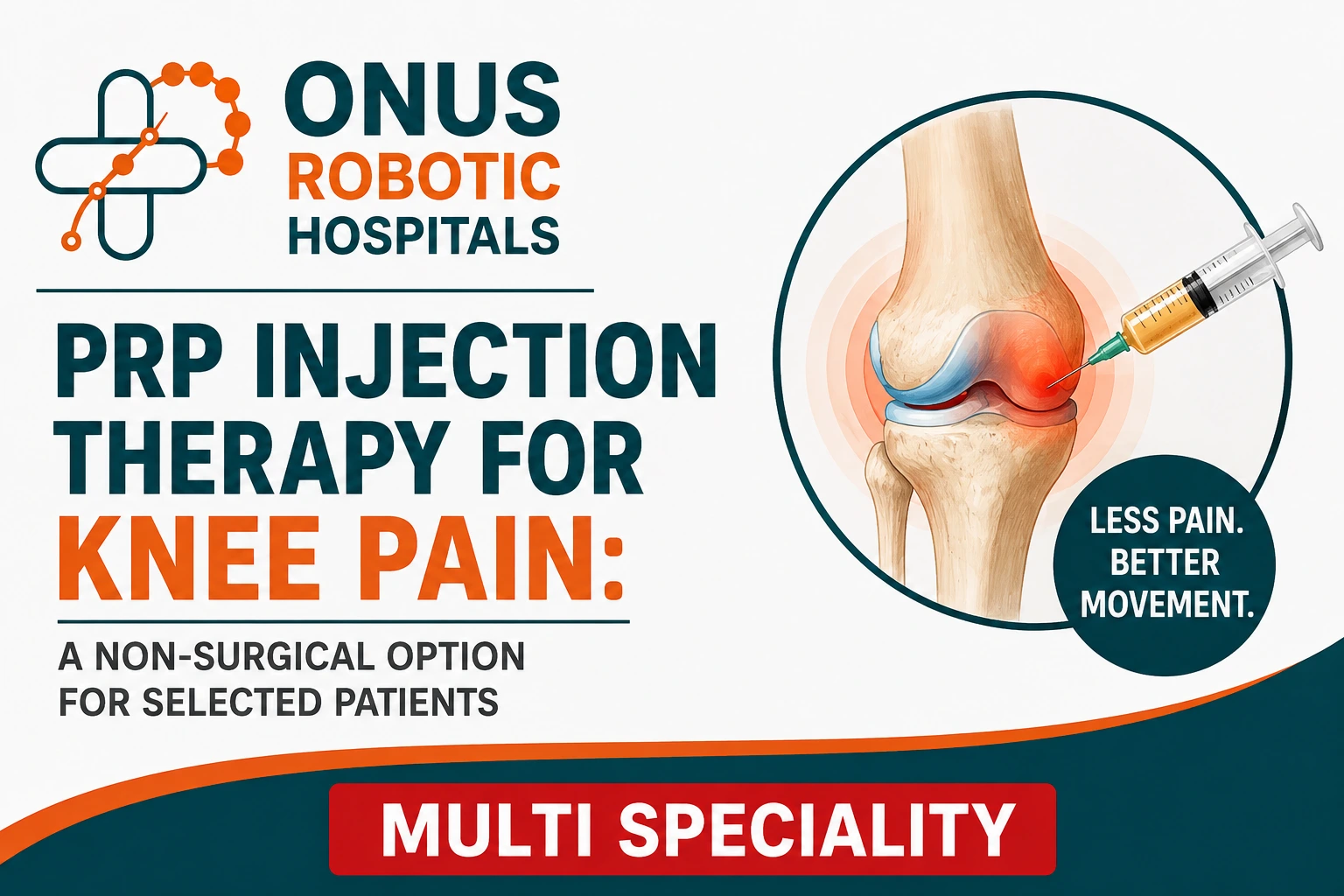
One such treatment is PRP (Platelet-Rich Plasma) Injection Therapy, which has gained attention as a regenerative treatment option for selected patients with knee osteoarthritis.
According to Dr. Balaraju Naidu, Robotic Orthopedic Surgeon at ONUS Robotic Hospitals, proper evaluation is essential to determine whether PRP is appropriate for a patient’s specific condition.
Understanding Knee Osteoarthritis
Osteoarthritis is a degenerative joint condition that occurs when the protective cartilage covering the ends of bones gradually wears away.
As cartilage deteriorates:
- Joint surfaces become rough
- Friction increases
- Inflammation develops
- Pain and stiffness worsen
- Movement becomes restricted
Over time, everyday activities can become increasingly difficult.
Common Symptoms of Knee Osteoarthritis
Patients with knee arthritis may experience:
Knee Pain
Pain may occur during walking, standing, climbing stairs, or after prolonged activity.
Morning Stiffness
The knee may feel stiff after waking up or after sitting for long periods.
Swelling
Inflammation within the joint can cause visible swelling.
Reduced Mobility
Patients often notice difficulty bending or straightening the knee.
Grinding Sensation
Some people experience clicking, cracking, or grinding sounds during movement.
Difficulty Walking
As arthritis progresses, walking longer distances becomes more challenging.
What Is PRP (Platelet-Rich Plasma) Therapy?
PRP stands for Platelet-Rich Plasma, a concentrated preparation derived from the patient’s own blood.
Platelets are natural blood components that contain growth factors and proteins involved in tissue repair and healing processes.
PRP therapy involves:
- Drawing a small amount of the patient’s blood.
- Processing it using specialized equipment.
- Separating platelet-rich plasma from other blood components.
- Injecting the concentrated PRP into the affected knee joint.
The procedure is performed under medical supervision after proper orthopedic evaluation.
How PRP May Help Knee Pain
PRP therapy is designed to support the body’s natural healing response.
In selected patients, PRP may help:
Reduce Pain
Some patients report reduced knee discomfort after treatment.
Improve Joint Function
Better movement and improved daily activity performance may be possible.
Enhance Mobility
Reduced symptoms can support more comfortable walking and physical activity.
Improve Quality of Life
Less pain often allows patients to remain active and independent.
However, results vary between individuals.
Who May Benefit From PRP Therapy?
PRP is not suitable for every patient with knee arthritis.
It may be considered for selected individuals with:
- Early-stage osteoarthritis
- Mild to moderate cartilage wear
- Persistent knee pain
- Functional limitations despite conservative treatment
- Desire to explore non-surgical treatment options
The decision should always be based on clinical evaluation and imaging findings.
Is PRP Suitable for Advanced Arthritis?
This is one of the most important questions patients ask.
While PRP may help selected patients with early-stage arthritis, advanced osteoarthritis often requires different treatment approaches.
In severe arthritis:
- Cartilage loss may be extensive
- Joint deformity may be present
- Functional limitations may be significant
In such cases, PRP may not provide the desired results, and other treatment options—including knee replacement surgery—may need to be considered.
Why Proper Evaluation Is Essential
No two patients with knee pain are exactly alike.
A thorough orthopedic assessment helps determine:
- The stage of arthritis
- Severity of symptoms
- Joint alignment
- Functional limitations
- Previous treatments
- Overall health status
Proper evaluation helps ensure the right treatment is selected for the right patient.
Investigations Before PRP Treatment
Depending on the patient’s condition, evaluation may include:
Clinical Examination
Assessment of pain, mobility, stability, and function.
X-Rays
Help determine the extent of joint degeneration.
Additional Imaging
In selected cases, MRI or other investigations may be required.
These assessments help determine whether PRP is likely to be beneficial.
Other Non-Surgical Treatment Options
PRP is only one part of comprehensive knee arthritis management.
Other treatment options may include:
Physiotherapy
Exercises to strengthen muscles around the knee.
Weight Management
Reducing body weight decreases stress on knee joints.
Medications
Pain-relieving and anti-inflammatory medicines may help manage symptoms.
Activity Modification
Adjusting daily activities can reduce joint strain.
Assistive Devices
Braces or supports may improve comfort and function.
The best results often come from combining multiple treatment strategies.
When Is Knee Replacement Considered?
For patients with advanced arthritis, severe pain, and significant loss of function, knee replacement surgery may become the most effective treatment option.
Surgery may be considered when:
- Pain is persistent
- Walking becomes difficult
- Daily activities are severely affected
- Conservative treatments no longer provide relief
The decision is individualized and based on the patient’s overall condition.
Benefits of Early Orthopedic Consultation
Seeking evaluation early may provide more treatment options.
Benefits include:
- Early diagnosis
- Better symptom management
- Slower progression of disability
- Improved mobility
- Personalized treatment planning
The earlier arthritis is identified, the more opportunities there may be for non-surgical management.
Less Pain. Better Movement. A Stronger Step Forward.
PRP Injection Therapy may offer a non-surgical treatment option for selected patients with knee osteoarthritis. While it is not a cure for arthritis and may not be suitable for everyone, it can help some individuals improve mobility and manage symptoms more effectively.
The key is proper diagnosis and individualized treatment planning.
Conclusion
Knee osteoarthritis can significantly affect daily life, limiting mobility and reducing quality of life. PRP Injection Therapy is an emerging treatment option that may help selected patients reduce pain and improve function without immediate surgery.
However, PRP is not appropriate for every stage of arthritis. A detailed orthopedic evaluation remains essential to determine whether PRP, physiotherapy, medications, injections, or surgery is the most suitable approach.
Dr. Balaraju Naidu emphasizes that successful treatment begins with accurate diagnosis, proper patient selection, and choosing the right treatment at the right time.
For Appointments:
Dr. Balaraju Naidu, Robotic Orthopedic Surgeon
ONUS Robotic Hospitals – Hyderabad
👉 link: contact-us or book-appointment