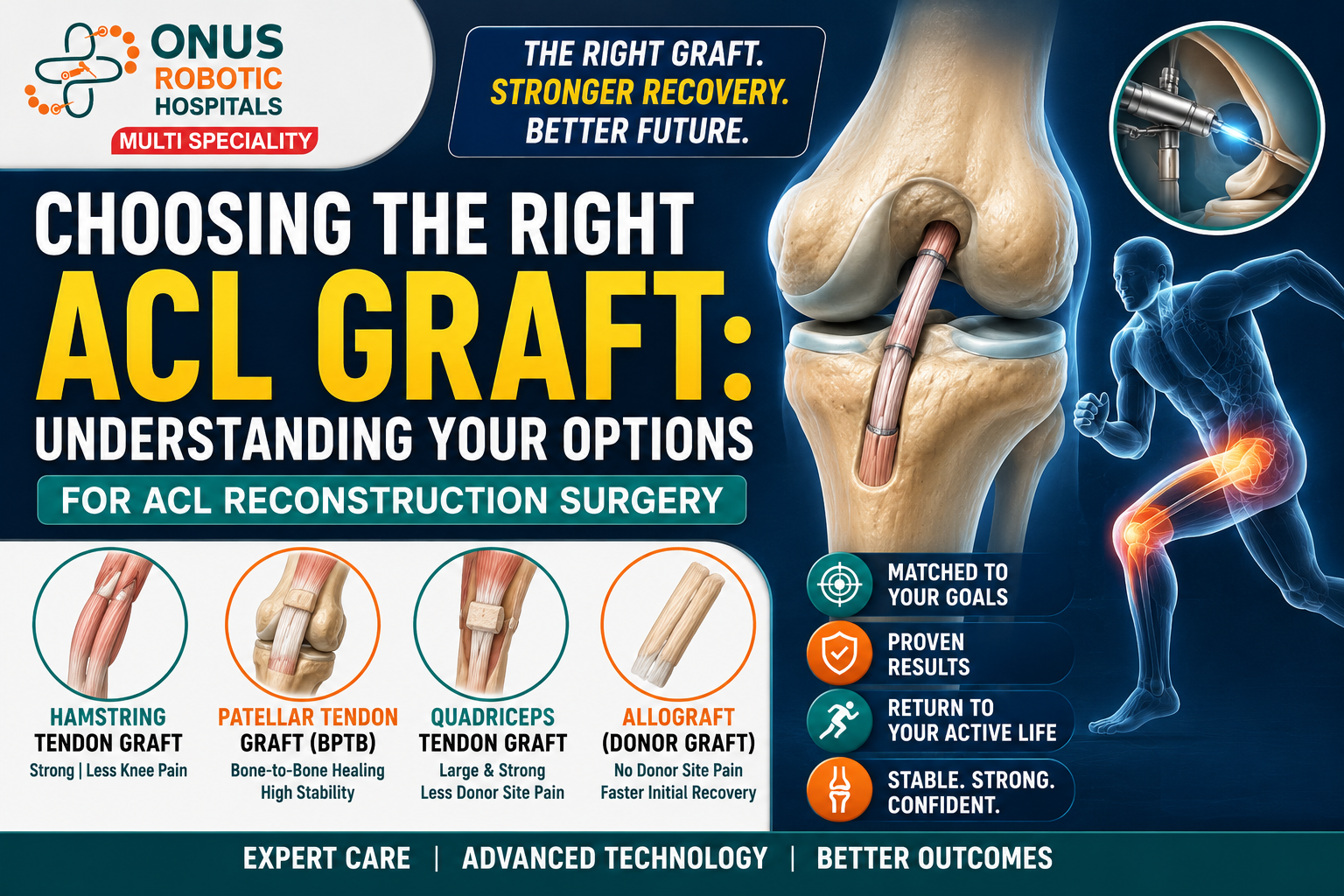
Choosing the Right ACL Graft: Understanding Your Options for ACL Reconstruction Surgery- By Dr. K. Sai Prajwal Reddy, Consultant Arthroscopy, ONUS Robotic Hospitals
If you need ACL Reconstruction, one of the most important decisions is choosing the right graft.
The graft is the tissue used to replace your torn ACL and restore knee stability. The ideal graft depends on several factors, including:
- Age
- Activity level
- Type of sports played
- Occupation
- Previous knee surgeries
- Recovery goals
At ONUS Robotic Hospitals, specialists like Dr. Balaraju Naidu help patients understand graft options so they can make informed decisions based on lifestyle and long-term knee health.
Why Is the ACL Important?
The Anterior Cruciate Ligament (ACL) is one of the key stabilizing ligaments of the knee.
It helps with:
- Pivoting
- Twisting
- Running
- Sudden direction changes
- Sports activities
When the ACL tears, the knee may feel:
- Unstable
- Painful
- Weak
- Like it may “give way”
ACL reconstruction helps restore stability and function.
What Is an ACL Graft?
During ACL surgery, the torn ligament is replaced with a graft that acts as a new ACL.
The graft gradually incorporates into the body and functions like a natural ligament over time.
Main ACL Graft Options
There is no “one-size-fits-all” graft. Each option has advantages and limitations.
1. Hamstring Tendon Graft (Autograft)
What Is It?
This graft uses tendons from the back of the thigh (hamstring tendons).
The tendons are folded to create a strong new ligament.
Who Is It Best For?
- Younger patients
- Running and jumping athletes
- Patients wanting smaller scars
- Those wishing to avoid kneecap pain
Advantages
✔ Strong graft with excellent outcomes
✔ Less pain around kneecap
✔ Smaller incision scars
✔ Faster early comfort
Possible Limitations
⚠ Temporary hamstring weakness
⚠ Slight risk of graft stretching in some cases
3. Quadriceps Tendon Graft
What Is It?
Uses part of the quadriceps tendon above the kneecap.
Sometimes includes a small bone plug.
Who Is It Best For?
- Revision surgeries
- Patients with previous graft harvests
- Those wanting a larger graft
Advantages
✔ Large, thick graft
✔ Strong fixation
✔ Less kneecap pain than patellar tendon graft
✔ Good option for complex cases
Possible Limitations
⚠ Temporary quadriceps weakness
⚠ Requires surgeon experience
4. Allograft (Donor Graft)
What Is It?
Uses tissue from a screened donor.
Can include:
- Patellar tendon
- Hamstring tendon
- Achilles tendon
Who Is It Best For?
- Older patients
- Multi-ligament injuries
- Revision ACL surgeries
- Patients wanting less donor-site pain
Advantages
✔ No graft harvesting from your body
✔ Less postoperative pain initially
✔ Shorter surgery time
Possible Limitations
⚠ Slightly higher failure risk in young athletes
⚠ Slower biological incorporation
⚠ Extremely small disease transmission risk
Which ACL Graft Is Best?
There is no universally “best” graft.
The best graft is the one that matches your:
- Activity level
- Sports goals
- Knee anatomy
- Lifestyle needs
General Recommendations
Contact Sports Athletes
👉 Patellar tendon graft often preferred
Running / Jumping Sports
👉 Hamstring or quadriceps tendon graft
Recreational Sports & Daily Activities
👉 Hamstring, quadriceps, or allograft
Revision ACL Surgery
👉 Quadriceps tendon or allograft
What Happens During Consultation?
Your orthopedic surgeon may evaluate:
- MRI findings
- Knee stability
- Sports goals
- Age and activity level
- Previous surgeries
This helps determine the most suitable graft option.
Recovery After ACL Reconstruction
Recovery depends on:
- Graft type
- Rehabilitation
- Muscle strength
- Activity goals
General Recovery Timeline
Early Phase (0–6 Weeks)
- Swelling control
- Walking with support
- Range of motion exercises
Intermediate Phase (6–12 Weeks)
- Strengthening
- Balance training
Advanced Phase (3–6 Months)
- Running progression
- Sport-specific rehab
Return to Sports
Usually after:
👉 6–9 months (or longer depending on recovery)
Final Takeaway
ACL reconstruction is highly successful when:
✔ Correct graft is selected
✔ Surgery is properly performed
✔ Rehabilitation is followed consistently
👉 The goal is not just healing—but returning to life with a stable, confident knee.
For Appointments:
Dr.K.Sai Prajwal Reddy, Robotic Orthopedic Surgeon
ONUS Robotic Hospitals – Hyderabad
👉 link: contact-us or book-appointment