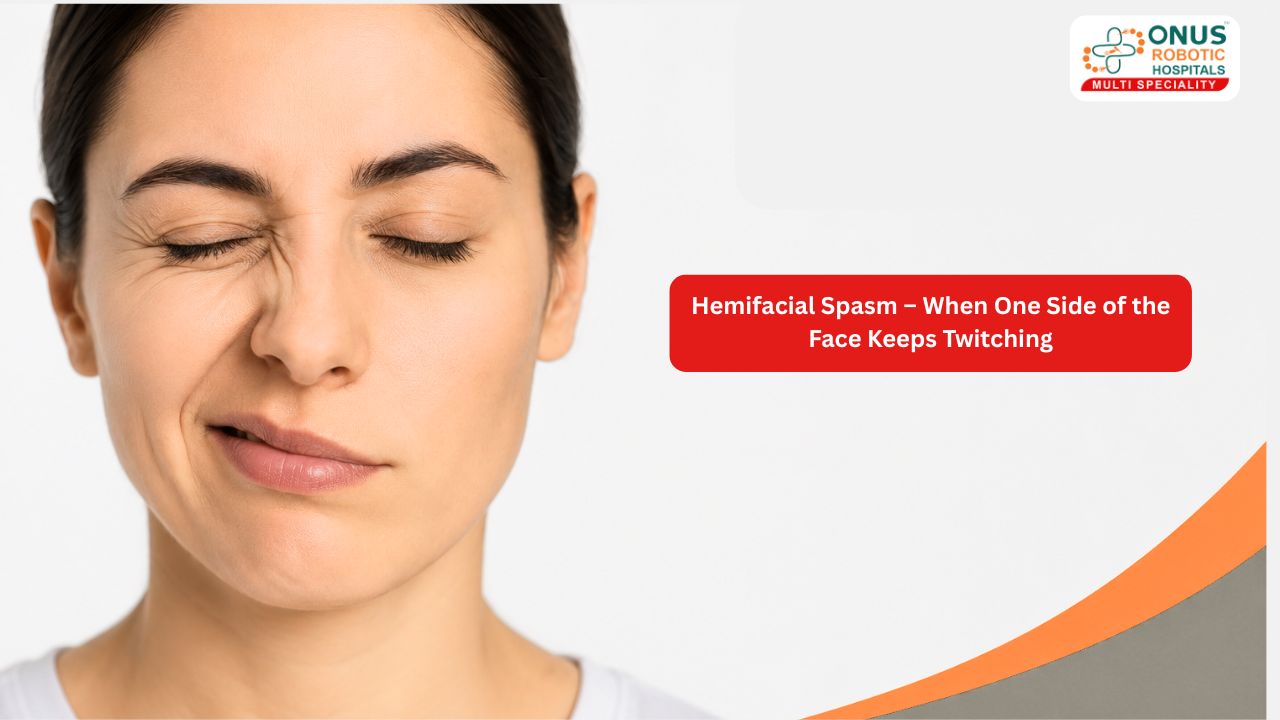
Hemifacial Spasm – When One Side of the Face Keeps Twitching – By Dr.Krishna Chaithanya Reddy, Neurologist, ONUS Robotic Hospitals
Have you ever noticed repeated twitching on one side of the face that just doesn’t stop?
It may begin as mild eyelid twitching and slowly spread to the cheek, mouth, or neck. Many people initially ignore it, assuming it is caused by stress, tiredness, or lack of sleep. However, persistent involuntary facial movements may indicate a neurological condition called Hemifacial Spasm.
At ONUS Robotic Hospitals, our neurology specialists provide advanced evaluation and treatment for facial nerve disorders using modern imaging, Botox therapy, and neurosurgical approaches.
What is Hemifacial Spasm?
Hemifacial Spasm is a neurological movement disorder in which muscles on one side of the face contract involuntarily.
The condition usually starts around the eye and gradually progresses to involve the cheek, mouth, jaw, and neck muscles. Over time, spasms may become frequent, forceful, and socially distressing.
It commonly affects:
- Middle-aged adults
- Women slightly more than men
- Usually only one side of the face
Why Does Hemifacial Spasm Occur?
The most common cause is compression of the facial nerve by a nearby blood vessel.
The facial nerve controls facial expressions and muscle movements. When an artery continuously pulsates against the nerve near the brainstem, it irritates the nerve and produces abnormal electrical signals that trigger muscle spasms.
Other Possible Causes
Less common causes include:
✔ Previous facial nerve injury
✔ Recovery changes after Bell’s palsy
✔ Tumors near the facial nerve
✔ Rare neurological disorders
Common Symptoms of Hemifacial Spasm
Symptoms usually develop gradually and worsen over time.
Early Symptoms
👉 Intermittent eyelid twitching
👉 Excessive blinking
👉 Eye closure during stress or fatigue
Advanced Symptoms
👉 Twitching spreading to cheek and mouth
👉 Pulling of one side of the face
👉 Facial tightness or discomfort
👉 Difficulty reading or driving due to eye closure
👉 Facial movements even during sleep
Some patients may also notice:
- Clicking sounds in the ear
- Facial discomfort
- Social embarrassment or anxiety due to visible spasms
Triggers That Can Worsen Symptoms
Spasms often become more noticeable during:
✔ Stress
✔ Anxiety
✔ Fatigue
✔ Lack of sleep
✔ Excess caffeine intake
✔ Emotional excitement
Although these factors worsen symptoms, they are usually not the primary cause of the disorder.
Is Hemifacial Spasm Dangerous?
Hemifacial Spasm is usually not life-threatening, but it can significantly affect quality of life.
Patients may experience:
- Reduced confidence
- Social discomfort
- Disturbed vision due to eye closure
- Sleep problems
- Difficulty performing daily activities
Severe long-standing spasms can sometimes cause facial muscle fatigue.
Diagnosis of Hemifacial Spasm
Diagnosis is primarily clinical and performed by a neurologist.
Clinical Evaluation
Doctors assess:
- Pattern of facial twitching
- Nerve involvement
- Frequency and severity of spasms
- Facial muscle function
Imaging & Investigations
✔ MRI Brain with Vascular Imaging
MRI helps identify:
- Facial nerve compression
- Blood vessels pressing on the nerve
- Tumors or structural abnormalities
✔ Electrophysiological Studies
Rarely required in selected patients.
Treatment Options for Hemifacial Spasm
Treatment depends on symptom severity and patient preference.
1. Botulinum Toxin (Botox) Injections
Botox injections are considered the most effective and commonly used treatment for Hemifacial Spasm.
Small doses are injected into affected facial muscles to reduce abnormal contractions.
Benefits of Botox Therapy
✔ Highly effective
✔ Minimally invasive
✔ Relief usually starts within days
✔ Results last approximately 3–4 months
✔ Improves comfort and confidence
Most patients experience major improvement in daily life after treatment.
2. Medications
Some medicines may help reduce symptoms temporarily, including:
✔ Carbamazepine
✔ Clonazepam
✔ Baclofen
However, medications are generally less effective than Botox injections.
3. Microvascular Decompression Surgery
In selected patients, surgery may provide a long-term cure.
What Happens During Surgery?
The neurosurgeon:
- Identifies the blood vessel compressing the facial nerve
- Carefully separates it from the nerve
This procedure is called Microvascular Decompression (MVD) and is especially beneficial in younger patients with severe symptoms.
Lifestyle Measures to Reduce Symptoms
Although lifestyle modifications cannot cure Hemifacial Spasm, they may help reduce symptom severity.
Helpful Measures
✔ Adequate sleep
✔ Stress management
✔ Limiting caffeine intake
✔ Relaxation techniques
✔ Avoiding exhaustion
When Should You Consult a Neurologist?
Seek medical evaluation if:
⚠ Facial twitching persists for weeks
⚠ One side of the face repeatedly contracts
⚠ Eye closure interferes with daily activities
⚠ Twitching gradually worsens
⚠ Associated facial weakness develops
Early diagnosis and treatment can significantly improve quality of life.
Frequently Asked Questions
Is Hemifacial Spasm the Same as Eyelid Twitching?
No. Simple eyelid twitching is usually temporary, while Hemifacial Spasm progressively affects larger areas of one side of the face.
Can Stress Alone Cause Hemifacial Spasm?
Stress may worsen symptoms, but the underlying problem is usually facial nerve irritation or compression.
Is Botox Safe?
When performed by experienced specialists, Botox is generally very safe and highly effective.
Can Hemifacial Spasm Be Permanently Cured?
Some patients achieve long-term relief or cure with microvascular decompression surgery.
Advanced Neurology Care at ONUS Robotic Hospitals
At ONUS Robotic Hospitals, our neurology team offers comprehensive care for neurological movement disorders with advanced imaging and treatment facilities.
Advanced Facilities
✔ AI Neuro & Cardiac Cath Lab
✔ Advanced Neurology Care
✔ MRI & Neuro Imaging
✔ Minimally Invasive Treatment
✔ Rehabilitation & Physiotherapy
For Appointments:
Dr. Krishna Chaithanya Reddy
Consultant – Interventional Neurologist
ONUS Robotic Hospitals – Hyderabad
👉 link: contact-us or book-appointment