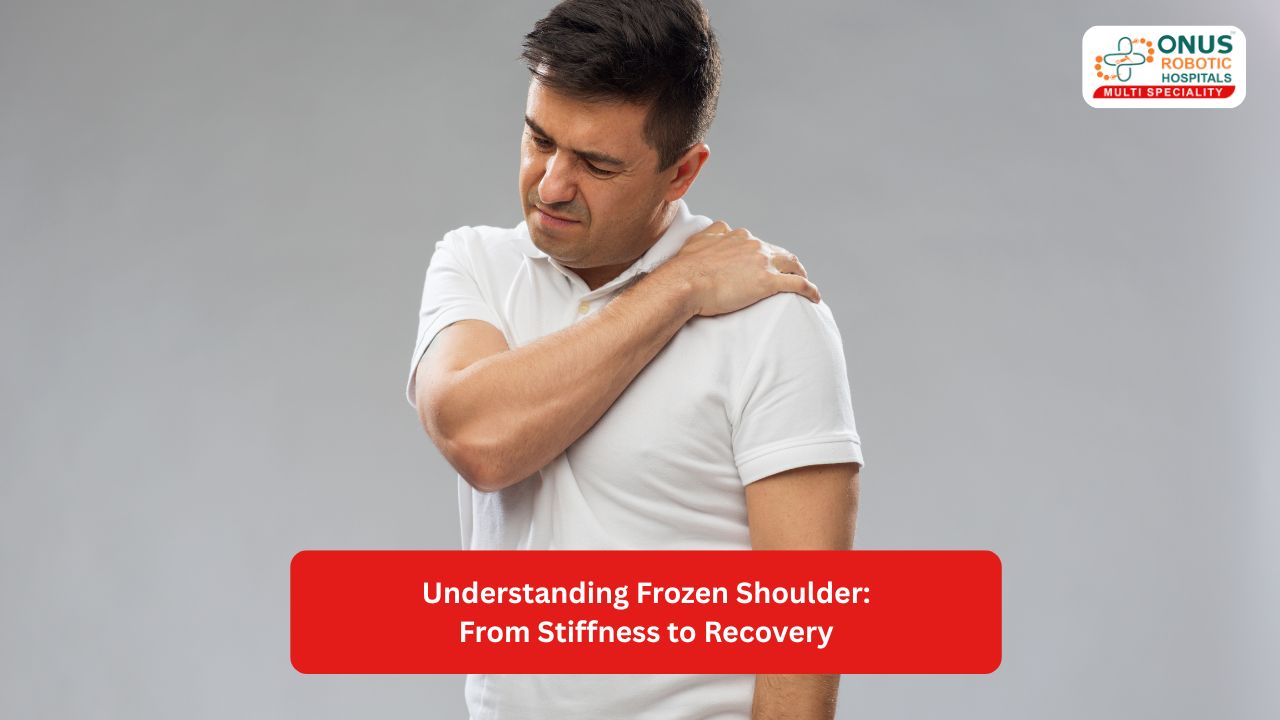
Understanding Frozen Shoulder: From Stiffness to Recovery- By Dr. K. Sai Prajwal Reddy, Consultant Arthroscopy, ONUS Robotic Hospitals
Adhesive capsulitis, commonly known as frozen shoulder, is a condition characterized by progressive pain and a significant loss of both active and passive range of motion. It occurs when the strong connective tissue surrounding the shoulder joint (the shoulder capsule) becomes thick, stiff, and inflamed.
While the exact cause isn’t always clear, it is frequently seen in individuals with diabetes , Hypothyroid , Dyslipidemia or those recovering from a medical procedure or injury that prevents the arm from moving.
The Natural Course: The Three Stages
Frozen shoulder typically follows a predictable clinical pattern that can last anywhere from one to three years.
- The Freezing Stage (2–9 months):
- Pain gradually increases, often worsening at night.
- The shoulder begins to lose range of motion as the capsule thickens.
- The Frozen Stage (4–12 months):
- Pain may actually begin to subside, but the stiffness becomes profound.
- Daily activities like reaching into a back pocket or combing hair become nearly impossible.
- The Thawing Stage (5–24 months):
- The shoulder’s range of motion slowly begins to improve.
- Strength and mobility eventually return to near-normal levels for most patients.
Early Intervention: Managing Pain and Mobility
In the initial “freezing” phase, the primary goals are inflammation control and maintaining whatever mobility remains.
- Analgesics and NSAIDs: Medications are used to manage the dull ache and reduce the inflammatory response within the capsule.
- Capsule Stretching: Physical therapy is the cornerstone of early treatment. Controlled, gentle stretching exercises help prevent the capsule from tightening further.
- Codman’s Pendulum: Leaning forward and swinging the arm in small circles.
- Towel Stretches: Using a towel to gently pull the affected arm into internal rotation.
Advanced Non-Surgical Options
If conservative measures don’t yield results after 2 months, more targeted interventions are considered.
- Intra-articular Injections: A corticosteroid injection is delivered directly into the shoulder joint . This provides a potent anti-inflammatory “reset,” significantly reducing pain and allowing the patient to participate more effectively in physical therapy.
- Hydrodilatation: This involves injecting a large volume of sterile saline along with the steroid to physically stretch (expand) the joint capsule from the inside out.
Surgical Intervention: When Conservative Care Fails
When the “frozen” stage persists and quality of life is severely impacted, surgical options may be discussed.
1. Manipulation Under Anesthesia (MUA)- Not Advised
The surgeon moves the shoulder through its full range of motion while the patient is asleep. This “breaks” the adhesions and scar tissue. However, this is less common today due to the risk of fractures or labral tears.
2. Arthroscopic Adhesiolysis
This is the modern gold standard for refractory frozen shoulder. Using a tiny camera (arthroscope) and specialized tools, the surgeon performs a capsular release.
- The surgeon cuts through the tightest portions of the capsule.
- The thickened tissue is removed or divided.
- This provides an immediate mechanical improvement in the range of motion.
Recovery and Outlook
Regardless of the treatment path—whether it’s simple stretching or a surgical release—post-procedure physical therapy is vital. Without immediate and consistent movement following an injection or surgery, the body may simply form new adhesions, leading to a recurrence of the stiffness. With patience and the right clinical approach, the vast majority of patients regain full function and return to their normal lives.
For Appointments:
Dr.K.Sai Prajwal Reddy, Robotic Orthopedic Surgeon
ONUS Robotic Hospitals – Hyderabad
👉 link: contact-us or book-appointment