Understanding Patella Dislocation and MPFL Injuries- By Dr. K. Sai Prajwal Reddy, Consultant Arthroscopy, ONUS Robotic Hospitals
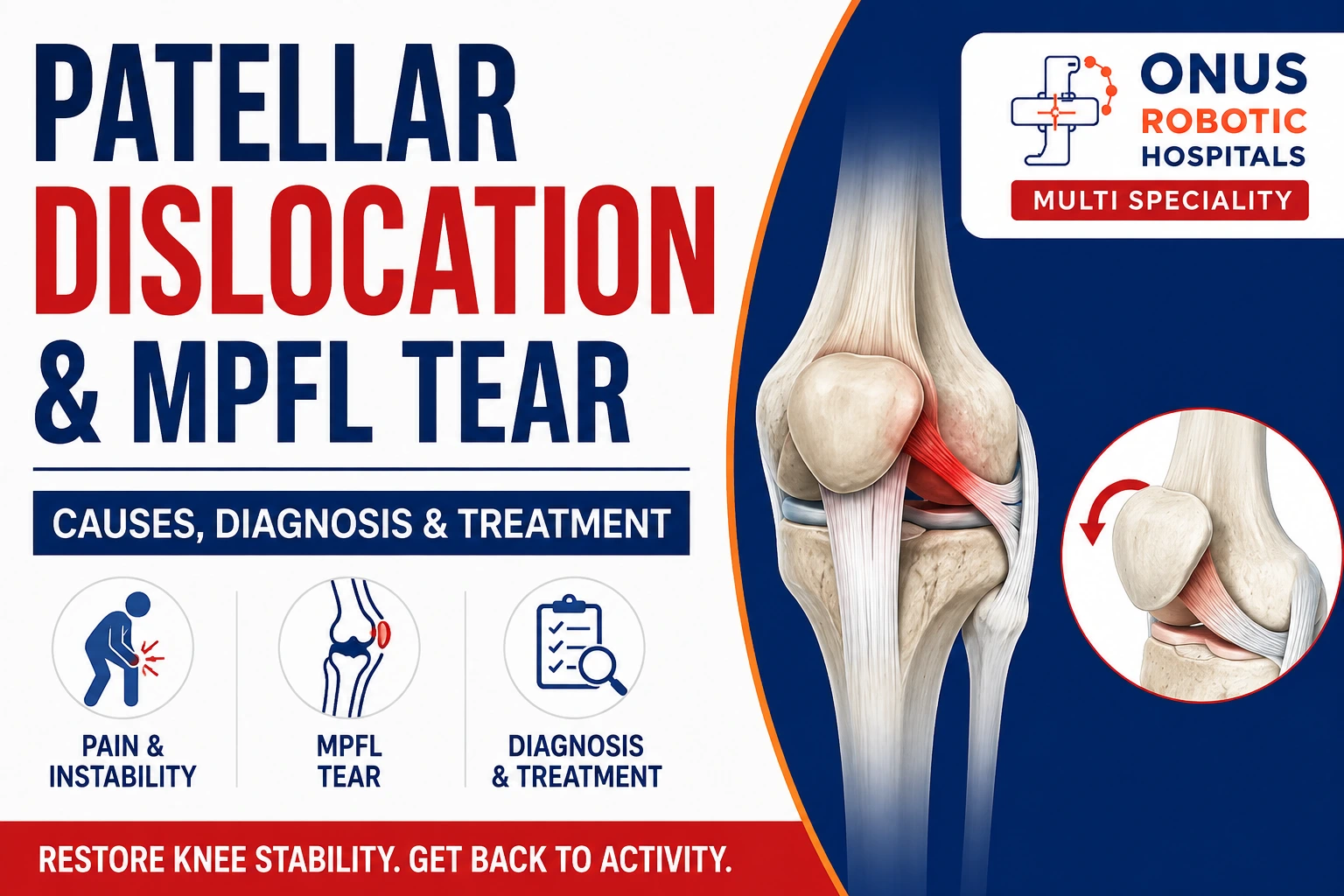
A patellar dislocation occurs when the kneecap (patella) pops out of its vertical groove—the trochlea—at the end of the thigh bone. This is rarely a “quiet” injury; it’s usually a sharp, painful event often involving a “pop” and immediate swelling.
At the heart of this stability is the Medial Patellofemoral Ligament (MPFL). This is a thin band of tissue on the inner side of the knee that acts as a tether, preventing the kneecap from sliding outward. When the patella dislocates, the MPFL is almost always stretched or torn.
The Path to Recovery: Conservative Treatment
While recurrent dislocations or severe bone chips might require surgery, the vast majority of first-time patellar dislocations are managed conservatively (without surgery). The goal is to allow the MPFL to heal while retraining the muscles to take over the job of stabilization.
1. Phase One: Protection and “POLICE”
The first 48–72 hours focus on calming the joint down. Many clinicians use the POLICE principle:
- Protection: Using a brace or crutches to avoid further stress.
- Optimal Loading: Gentle movement as pain allows.
- Ice: To manage pain and swelling.
- Compression: Using a knee Brace.
- Elevation: Keeping the knee on the pillows.
2. Immobilization and Bracing
Initially, your doctor may place you in a patellar stabilizer brace or a “J-brace.” These have a C-shaped or J-shaped buttress that physically pushes the kneecap inward, preventing it from drifting toward the danger zone on the outside of the knee.
3. The “VMO” and Hip Connection
This is the most critical part of conservative treatment. Since the MPFL is weakened, the muscles must work harder to track the kneecap correctly.
- The VMO (Vastus Medialis Oblique): This is the teardrop-shaped muscle on the inner thigh. Strengthening it helps pull the patella medially (inward).
- Hip Abductors and External Rotators: If your hips are weak, your knee tends to “collapse” inward (valgus stress), which makes a dislocation more likely. Strengthening the glutes is essential for patellar health.
Common Conservative Exercises
| Exercise | Purpose |
| Quad Sets | Engaging the thigh muscle without moving the joint. |
| Straight Leg Raises | Building hip and quad strength while keeping the knee stable. |
| Clamshells | Isolating the gluteus medius to improve leg alignment. |
| Terminal Knee Extensions | Specifically targeting the VMO in the final degrees of straightening. |
Why “Wait and See” is Often Better
For a first-time injury, the MPFL has a decent capacity to heal on its own if the knee is kept stable. Surgery is usually reserved for:
- Osteochondral fractures: Small pieces of bone or cartilage that broke off during the dislocation.
- Anatomical predispositions: Such as a very shallow trochlear groove.
- Chronic Instability: If the kneecap continues to “slip” despite months of dedicated physical therapy.
A Note on Patience: Recovery typically takes 6 to 12 weeks. Rushing back to pivoting sports (like soccer or basketball) before the muscles are strong enough is the most common reason for a second dislocation.
Summary
A patella dislocation is a setback, but it isn’t a guaranteed ticket to the operating room. By focusing on swelling management, bracing, and aggressive strengthening of the VMO and hips, most patients can return to their favorite activities with a knee that feels more stable than ever.
For Appointments:
Dr.K.Sai Prajwal Reddy, Robotic Orthopedic Surgeon
ONUS Robotic Hospitals – Hyderabad
👉 link: contact-us or book-appointment