Mouth Taping in Children: Why It Can Be Dangerous Without ENT Evaluation- By Consultant ENT Head & Neck Surgeon, ONUS Robotic Hospitals
Mouth Taping in Children: Why It Can Be Dangerous Without ENT Evaluation- By Consultant ENT Head & Neck Surgeon, ONUS Robotic Hospitals
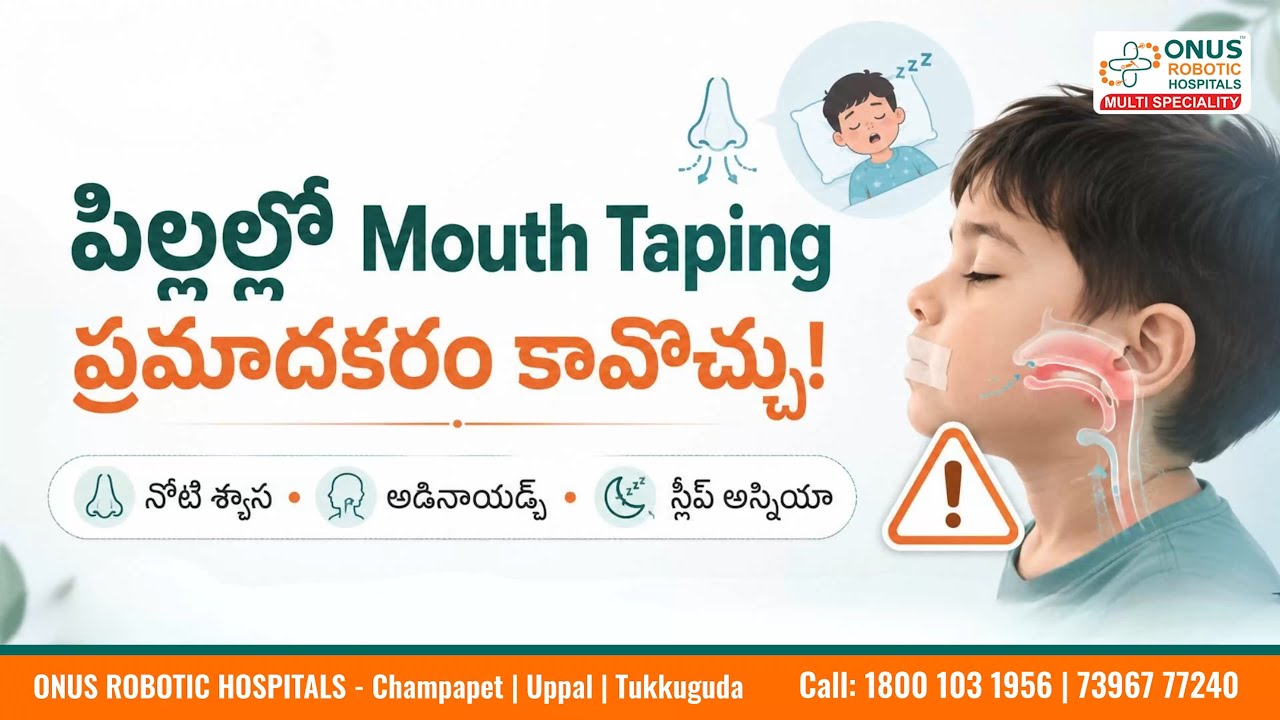
Mouth taping in children has become a social media trend, but it can be risky if done without medical evaluation. Many children breathe through the mouth not because of habit alone, but because they are unable to breathe comfortably through the nose.
Common reasons include blocked nose, enlarged adenoids, enlarged tonsils, allergies, sinus problems, deviated nasal septum, or sleep-disordered breathing. If a child has an underlying airway problem, taping the mouth may worsen breathing difficulty instead of solving the real issue.
In this awareness video, Dr. Akshitha Reddy, Consultant ENT Head & Neck Surgeon at ONUS Robotic Hospitals, explains why mouth taping in children can be dangerous, what causes mouth breathing, warning signs parents should watch for, and when ENT evaluation is needed.
What Is Mouth Taping?
Mouth taping means placing tape over the mouth during sleep to force nasal breathing. It is promoted on social media as a “sleep hack,” but it is not a safe solution for every child.
Children are not small adults. Their airways are smaller, and problems like adenoids, tonsils, allergy, nasal blockage, and sleep apnea are common. If the nose is blocked, taping the mouth can remove the child’s alternate breathing route.
Why Do Children Breathe Through the Mouth?
Children may breathe through the mouth due to several ENT and airway-related causes.
Cleveland Clinic notes that mouth breathing in children can be linked with sleep issues and may affect growth, behavior, and facial development in some cases.
Why Mouth Taping Can Be Risky in Children
Mouth taping may look simple, but it can cause serious discomfort and breathing problems, especially if the child has nasal obstruction or sleep apnea.
Possible risks include:
Breathing difficulty Anxiety or panic during sleep Skin irritation Allergic reaction to tape Disturbed sleep Worsening snoring or sleep apnea Reduced ability to breathe if nose gets blocked Delayed diagnosis of the real problem Risk if the child vomits or has congestion at night
Cleveland Clinic warns that mouth taping can cause difficulty breathing, skin irritation or allergic reactions, anxiety, and difficulty falling or staying asleep, and says it is not recommended for people with snoring or sleep apnea.
Mouth Taping and Sleep Apnea Risk
Snoring in children should never be ignored. It may be a sign of enlarged adenoids, enlarged tonsils, nasal obstruction, or obstructive sleep apnea.
Sleep apnea means breathing repeatedly stops or becomes shallow during sleep. If a child already has sleep apnea, mouth taping may worsen breathing problems because it does not treat the airway blockage.
A JAMA summary notes that mouth breathing during sleep may be associated with obstructive sleep apnea severity, and airflow may be important in some patients with nasal obstruction.
Warning Signs of Sleep Apnea in Children
Parents should watch for:
Loud snoring Mouth breathing during sleep Pauses in breathing Gasping or choking during sleep Restless sleep Excessive sweating at night Bedwetting Morning headache Daytime sleepiness Poor concentration Irritability or hyperactivity Poor school performance Frequent blocked nose Enlarged tonsils Recurrent throat infections
If these symptoms are present, the child needs ENT evaluation rather than home remedies.
Blocked Nose, Adenoids and Tonsils
Children commonly breathe through the mouth when the nose is blocked. Enlarged adenoids can block the back of the nose, while enlarged tonsils can narrow the throat airway. Allergy can also cause swelling inside the nose and repeated blockage.
In such cases, mouth taping does not fix the root cause. The correct treatment depends on diagnosis.
Possible treatment may include:
Allergy treatment Nasal sprays Saline wash Treatment for sinus infection Adenoid evaluation Tonsil evaluation Sleep apnea assessment Endoscopic ENT examination Surgery only when medically required
Why Oxygen Drop During Sleep Can Be Serious
During sleep, children should breathe comfortably and maintain good oxygen levels. If airway obstruction causes repeated oxygen drops, it can disturb sleep quality and affect daytime behavior, learning, mood, and overall health.
Mouth taping may hide or worsen the problem if parents assume the child is simply “learning nose breathing.” Any snoring, gasping, breathing pause, or disturbed sleep should be assessed properly.
Safer Approach for Mouth Breathing in Children
Instead of taping the mouth, parents should identify why the child is mouth breathing.
Safer steps include:
Observe snoring and breathing pattern Check if the nose is blocked frequently Look for enlarged tonsils Avoid self-treatment based on social media trends Consult an ENT specialist Treat allergy or sinus issues Evaluate adenoids and tonsils Assess sleep apnea if symptoms are present Follow doctor-recommended treatment
Sleep Foundation notes that mouth taping may cause skin irritation, discomfort, disrupted sleep, or breathing issues, and should not be used by people with untreated sleep apnea, chronic nasal congestion, or difficulty breathing through the nose.
When Should Parents Consult an ENT Specialist?
Consult an ENT doctor if your child has:
Regular mouth breathing Snoring Blocked nose Repeated cold Poor sleep Breathing pauses during sleep Gasping or choking at night Enlarged tonsils Frequent throat infections Daytime tiredness Difficulty concentrating Nasal speech Poor weight gain or growth concerns Recurrent sinus or allergy symptoms
Early diagnosis helps treat the real cause and prevents unnecessary risk.
Expert Pediatric ENT Care at ONUS Robotic Hospitals
At ONUS Robotic Hospitals, children with mouth breathing, snoring, blocked nose, adenoids, tonsils, sinus issues, allergies, sleep apnea symptoms, and breathing-related ENT problems receive expert evaluation and personalized treatment.