Introduction
Finding a hard lump near a bone can be concerning, and many people immediately fear it could be cancer. However, not all bone growths are cancerous. Osteochondroma is the most common benign (non-cancerous) bone tumor, accounting for nearly 35–40% of all benign bone tumors.
It usually develops during childhood or adolescence while bones are still growing. Most osteochondromas remain harmless and do not require treatment. However, some may cause pain, restrict joint movement, compress nearby nerves or blood vessels, or rarely undergo malignant transformation.
At ONUS Robotic Hospitals, our orthopedic specialists provide comprehensive diagnosis and personalized treatment plans using advanced imaging and minimally invasive surgical techniques whenever required.
What is Osteochondroma?
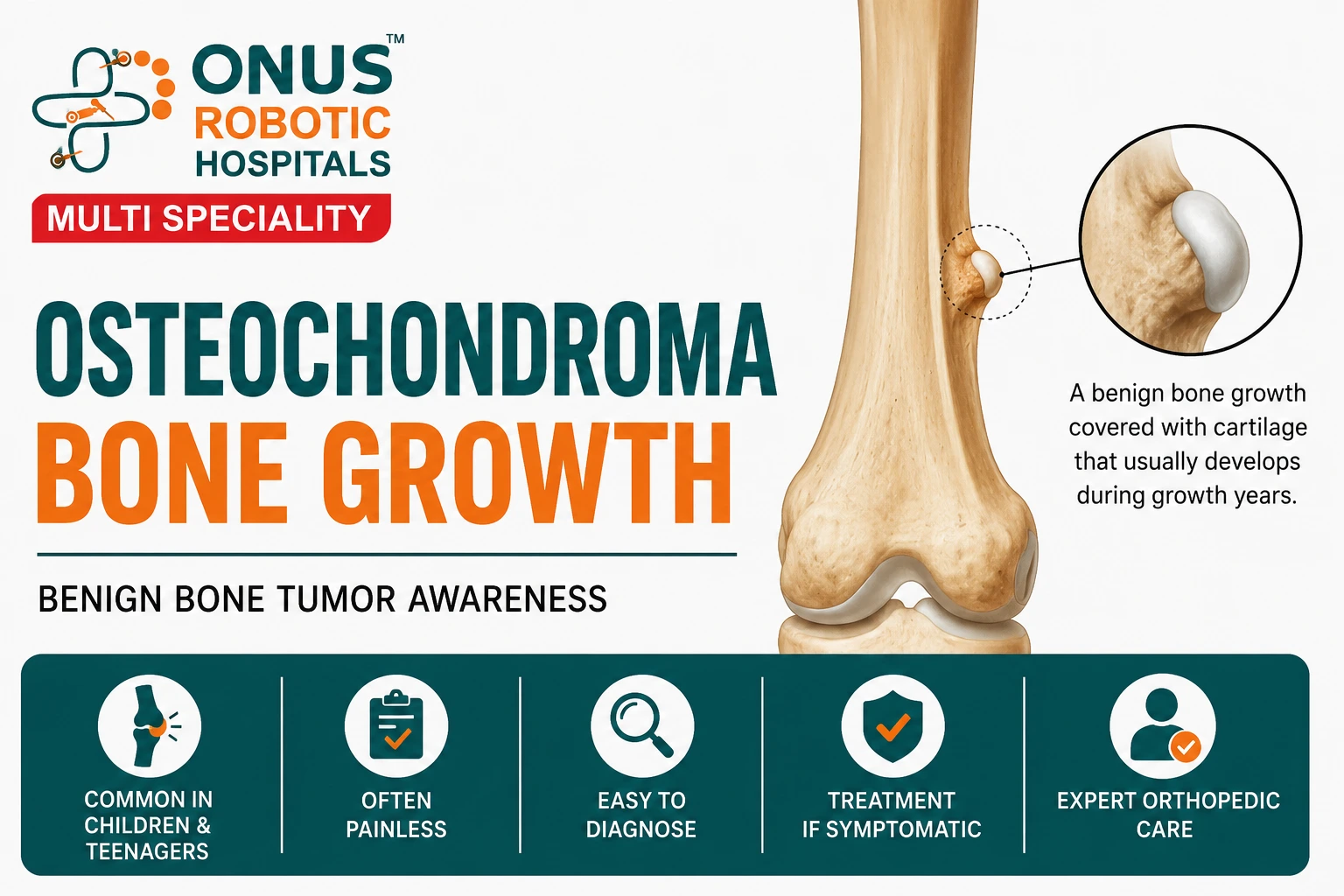
Osteochondroma is a benign bone growth covered by a cartilage cap that develops near the growth plate of a bone.
Unlike cancer, osteochondroma does not spread to other parts of the body. It usually stops growing once skeletal growth is complete.
It commonly occurs around long bones, especially:
- Femur (thigh bone)
- Tibia (shin bone)
- Humerus (upper arm)
- Pelvis
- Shoulder blade
Some people develop a single osteochondroma, while others inherit a condition called Hereditary Multiple Exostoses (HME), where multiple bone growths develop.
What Causes Osteochondroma?
The exact cause is not fully understood, but osteochondroma develops due to abnormal growth plate activity.
Possible causes include:
- Abnormal bone growth during childhood
- Genetic mutations
- Family history of Hereditary Multiple Exostoses (HME)
- Bone development disorders
Most cases are not caused by injury or lifestyle factors.
Who is at Risk?
Osteochondroma is more common in:
- Children and teenagers
- Individuals under 20 years of age
- People with a family history of HME
- Males slightly more than females
The growth usually stops after puberty when the bones finish growing.
Symptoms of Osteochondroma
Many osteochondromas cause no symptoms and are discovered incidentally during an X-ray performed for another reason.
When symptoms occur, they may include:
- Hard, painless lump near a bone
- Swelling around a joint
- Pain during physical activity
- Restricted joint movement
- Clicking or snapping sensation
- Difficulty bending the affected limb
- Numbness or tingling if nearby nerves are compressed
- Weakness in the affected limb
- Cosmetic deformity due to visible bone prominence
Symptoms depend on the size and location of the growth.
Common Locations of Osteochondroma
The condition most frequently affects areas around major joints, including:
Around the Knee
- Distal femur
- Proximal tibia
Upper Arm
- Proximal humerus
Pelvis
Shoulder Blade
Forearm Bones
Around the knee is the most common site of occurrence.
Is Osteochondroma Cancer?
No.
Osteochondroma is benign, meaning it is not cancer.
However, in rare cases (less than 1% for solitary osteochondroma), the cartilage cap may transform into a malignant tumor called chondrosarcoma.
Warning signs include:
- Sudden increase in size after skeletal maturity
- Persistent pain unrelated to activity
- Rapid enlargement of the lump
- New swelling
- Night pain
- Neurological symptoms such as numbness or weakness
Prompt medical evaluation is important if these symptoms develop.
How is Osteochondroma Diagnosed?
Orthopedic specialists diagnose osteochondroma using clinical examination and imaging studies.
Physical Examination
The doctor evaluates:
- Size of the lump
- Tenderness
- Joint movement
- Muscle strength
- Nerve function
X-ray
An X-ray is usually sufficient to diagnose osteochondroma and determine its location.
MRI Scan
MRI helps assess:
- Thickness of the cartilage cap
- Nerve compression
- Blood vessel involvement
- Suspicion of malignant change
CT Scan
CT scans provide detailed information for complex cases and surgical planning.
Treatment Options for Osteochondroma
Treatment depends on symptoms, age, and the location of the growth.
Observation
Most patients only require regular monitoring if the osteochondroma is:
- Small
- Painless
- Not restricting movement
- Not compressing nearby structures
Periodic follow-up with imaging may be recommended.
Pain Management
For mild symptoms, treatment may include:
- Pain-relieving medications
- Activity modification
- Anti-inflammatory medicines
Physiotherapy
Physical therapy helps improve:
- Joint flexibility
- Muscle strength
- Range of motion
- Functional recovery
Surgical Removal
Surgery may be recommended if the osteochondroma:
- Causes persistent pain
- Restricts joint movement
- Compresses nerves or blood vessels
- Continues growing after skeletal maturity
- Causes cosmetic concerns
- Shows signs of possible malignant transformation
The procedure involves complete removal of the bone growth and cartilage cap to reduce the risk of recurrence.
Recovery After Surgery
Recovery varies depending on the size and location of the tumor.
Most patients can expect:
- Pain control after surgery
- Gradual return to walking and daily activities
- Physiotherapy if needed
- Regular follow-up to monitor healing
Most individuals recover well and resume normal activities within a few weeks to months.
Possible Complications
If left untreated, symptomatic osteochondroma may lead to:
- Chronic pain
- Joint stiffness
- Reduced mobility
- Tendon irritation
- Nerve compression
- Blood vessel compression
- Fracture of the bone growth (rare)
- Very rare malignant transformation
Early diagnosis helps prevent these complications.
When Should You See an Orthopedic Specialist?
Consult a doctor if you notice:
- A hard lump near a bone
- Persistent swelling around a joint
- Pain that worsens over time
- Difficulty moving a joint
- Numbness or tingling
- Rapid growth of an existing bone lump
- Bone growth after skeletal maturity
Early evaluation ensures appropriate treatment and peace of mind.
Why Choose ONUS Robotic Hospitals?
At ONUS Robotic Hospitals, our experienced orthopedic specialists provide expert care for bone tumors and musculoskeletal disorders.
We Offer:
- Expert orthopedic consultations
- Advanced digital X-ray, MRI, and CT imaging
- Personalized treatment plans
- Minimally invasive surgical techniques
- Comprehensive physiotherapy and rehabilitation
- Patient-centered follow-up care
Frequently Asked Questions (FAQs)
Can osteochondroma disappear on its own?
No. The growth usually remains but often stops increasing in size after skeletal maturity.
Is surgery always required?
No. Many osteochondromas only need observation unless they cause symptoms or complications.
Can children develop osteochondroma?
Yes. It commonly develops during childhood and adolescence.
Can osteochondroma recur after surgery?
Recurrence is uncommon when the entire growth and cartilage cap are completely removed.
Is osteochondroma life-threatening?
In most cases, no. It is a benign condition with an excellent prognosis when properly managed.
Conclusion
Osteochondroma is the most common benign bone tumor and is usually harmless. However, persistent pain, restricted movement, nerve compression, or changes in the size of the growth should never be ignored.
Timely diagnosis and appropriate treatment can help prevent complications and improve quality of life. If you or your child notice a hard lump near a bone or experience unexplained joint pain, consult the orthopedic experts at ONUS Robotic Hospitals for a thorough evaluation and personalized care.
For Appointments:
Dr. Balaraju Naidu, Robotic Orthopedic Surgeon
ONUS Robotic Hospitals – Hyderabad
👉 link: contact-us or book-appointment