Introduction
Persistent hip pain, difficulty walking, stiffness, or reduced mobility should never be ignored. One possible cause of these symptoms is Avascular Necrosis (AVN) of the Hip, a condition that occurs when the blood supply to the femoral head (the ball portion of the hip joint) becomes reduced or interrupted.
Without adequate blood supply, the bone tissue gradually dies, causing structural damage to the hip joint. If left untreated, AVN can progress to joint collapse and severe arthritis, significantly affecting mobility and quality of life.
The good news is that early diagnosis offers more treatment options and may help preserve the natural hip joint.
In this article, Dr. Balaraju Naidu, Robotic Orthopedic Surgeon, explains the progression of AVN from Stage 1 to Stage 4 and discusses the treatment options available at each stage.
What Is Avascular Necrosis (AVN)?
Avascular Necrosis, also known as Osteonecrosis, is a condition in which the blood flow to a bone is reduced or completely blocked.
When this happens in the hip joint:
- Bone cells begin to die
- The femoral head weakens
- The bone structure gradually collapses
- Arthritis develops in advanced stages
The hip is one of the most commonly affected joints because it relies heavily on a delicate blood supply.
What Causes AVN of the Hip?
Several factors may increase the risk of developing AVN.
Common Causes and Risk Factors
- Long-term steroid use
- Alcohol abuse
- Hip injuries or fractures
- Dislocation of the hip
- Blood clotting disorders
- Autoimmune diseases
- Certain medical treatments
- Sickle cell disease
- Idiopathic causes (unknown reasons)
In many cases, AVN may develop without an obvious cause.
Common Symptoms of AVN
Symptoms often develop gradually and worsen as the disease progresses.
Early Symptoms
- Mild hip pain
- Groin pain
- Discomfort while walking
- Pain after physical activity
Progressive Symptoms
- Increasing hip pain
- Limping while walking
- Reduced range of motion
- Difficulty climbing stairs
- Pain even during rest
Advanced Symptoms
- Severe joint stiffness
- Significant mobility limitation
- Chronic pain
- Difficulty performing daily activities
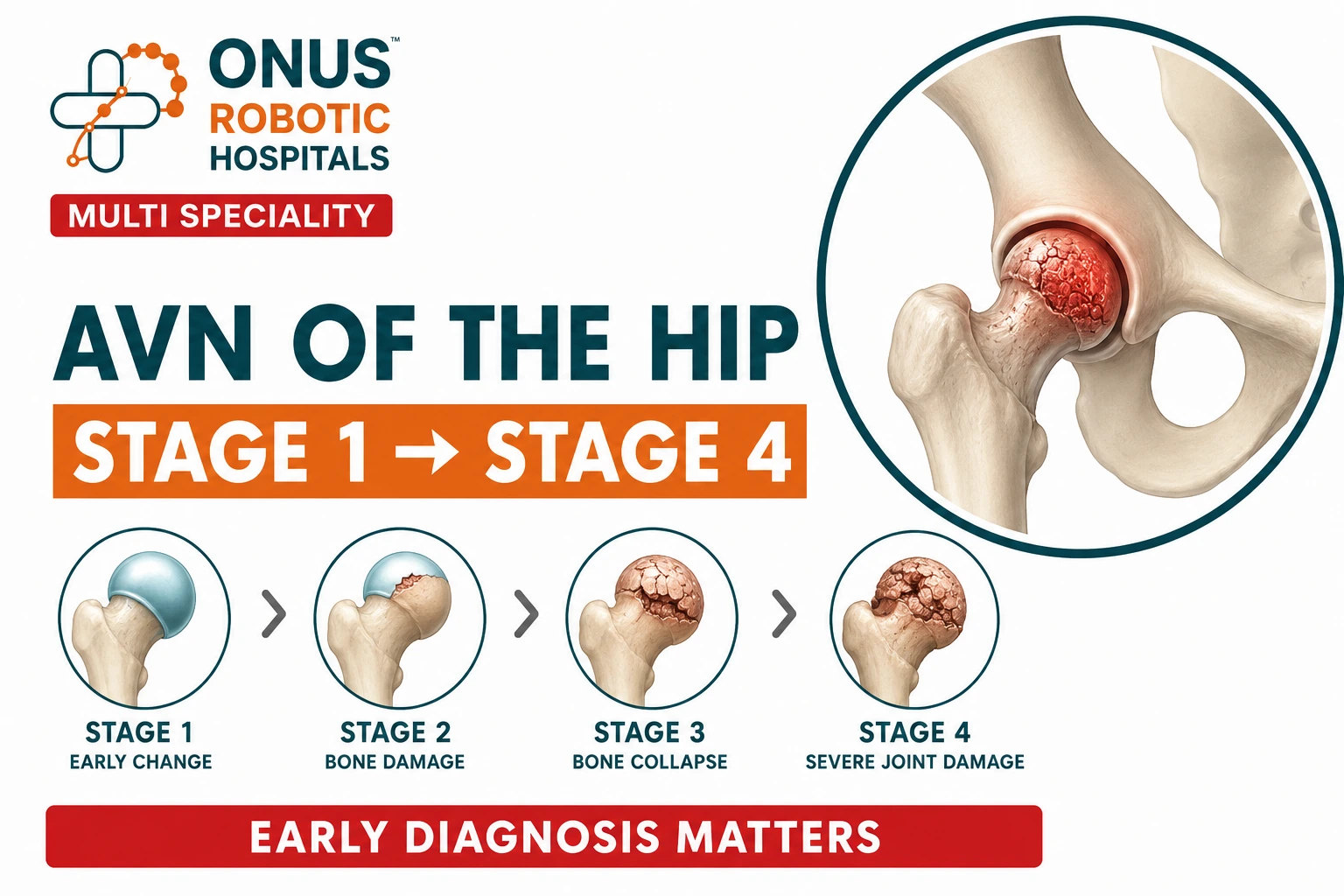
Understanding the Stages of AVN
AVN progresses through several stages. The stage of disease plays a major role in determining the most appropriate treatment.
Stage 1: Early AVN
At this stage:
- Blood supply has been affected
- Bone damage has started microscopically
- X-rays often appear normal
- MRI can detect early changes
Symptoms
- Mild hip pain
- Intermittent discomfort
- Pain during activity
Treatment Options
Early intervention offers the best opportunity to preserve the hip joint.
Treatment may include:
- Activity modification
- Medications
- Physiotherapy
- Core decompression in selected patients
MRI is particularly important because X-rays may not reveal Stage 1 disease.
Stage 2: Early Structural Changes
At Stage 2:
- Bone damage becomes more visible
- The femoral head maintains its shape
- X-rays begin to show abnormalities
Symptoms
- Increasing hip pain
- Walking discomfort
- Reduced mobility
Treatment Options
Joint-preserving procedures are often considered.
These may include:
Core Decompression
A surgical procedure that reduces pressure within the bone and may help improve blood flow.
Joint Preservation Techniques
Additional procedures may be considered depending on the patient’s age, disease severity, and MRI findings.
Early diagnosis at this stage can significantly improve outcomes.
Stage 3: Femoral Head Collapse Begins
At Stage 3:
- The femoral head begins to collapse
- Joint surface irregularities develop
- Cartilage damage may start
Symptoms
- Significant pain
- Limping
- Restricted movement
- Difficulty walking long distances
Treatment Options
Joint-preserving procedures become less effective once collapse occurs.
Depending on the extent of damage:
- Selected patients may still be evaluated for preservation procedures
- Hip replacement surgery may become necessary
Stage 4: Advanced Joint Damage
This is the most advanced stage of AVN.
At this stage:
- Femoral head collapse is significant
- Severe arthritis develops
- Joint destruction occurs
- Mobility is severely affected
Symptoms
- Severe pain
- Difficulty standing or walking
- Stiffness
- Loss of normal hip function
Treatment Options
Total Hip Replacement Surgery
Hip replacement is often the most effective treatment for advanced AVN.
The damaged joint surfaces are replaced with artificial implants, allowing patients to regain mobility and reduce pain.
What Is Core Decompression?
Core decompression is one of the most commonly performed procedures for early-stage AVN.
How It Works
The surgeon creates small channels within the affected bone to:
- Reduce pressure
- Improve blood circulation
- Encourage healing
- Slow disease progression
This procedure is generally most beneficial in Stage 1 and selected Stage 2 patients before significant collapse occurs.
Benefits of Hip Replacement Surgery
For patients with advanced AVN, hip replacement can provide significant improvements.
Potential Benefits
- Pain relief
- Improved mobility
- Better quality of life
- Easier walking
- Improved ability to perform daily activities
- Return to routine activities
Modern hip replacement techniques have shown excellent long-term outcomes in appropriately selected patients.
Why Early Diagnosis Is Important
The earlier AVN is diagnosed, the greater the opportunity to preserve the natural hip joint.
Early Diagnosis Can:
- Prevent progression
- Increase treatment options
- Improve long-term outcomes
- Delay or avoid joint replacement
- Preserve mobility
MRI plays a crucial role in detecting AVN before significant bone damage occurs.
How Is AVN Diagnosed?
Clinical Evaluation
Doctors assess:
- Pain characteristics
- Mobility limitations
- Walking difficulties
- Medical history
Imaging Studies
X-rays
Useful in later stages of disease.
MRI Scan
The most sensitive test for detecting early AVN.
MRI can identify disease before changes appear on X-rays.
Conclusion
Avascular Necrosis (AVN) of the Hip is a progressive condition caused by reduced blood supply to the femoral head. As the disease advances from Stage 1 to Stage 4, treatment options change significantly.
In the early stages, procedures such as core decompression and joint-preserving treatments may help save the hip joint. However, once significant collapse and arthritis occur, hip replacement surgery often provides the best long-term solution.
Early diagnosis means more treatment options, better outcomes, and a greater chance of preserving joint function.
If you are experiencing persistent hip pain, limping, or difficulty walking, consult an orthopedic specialist for a thorough evaluation.
Dr. Balaraju Naidu, Robotic Orthopedic Surgeon, emphasizes that timely diagnosis and stage-appropriate treatment are essential for achieving the best outcomes in AVN of the Hip.
For Appointments:
Dr. Balaraju Naidu, Robotic Orthopedic Surgeon
ONUS Robotic Hospitals – Hyderabad
👉 link: contact-us or book-appointment