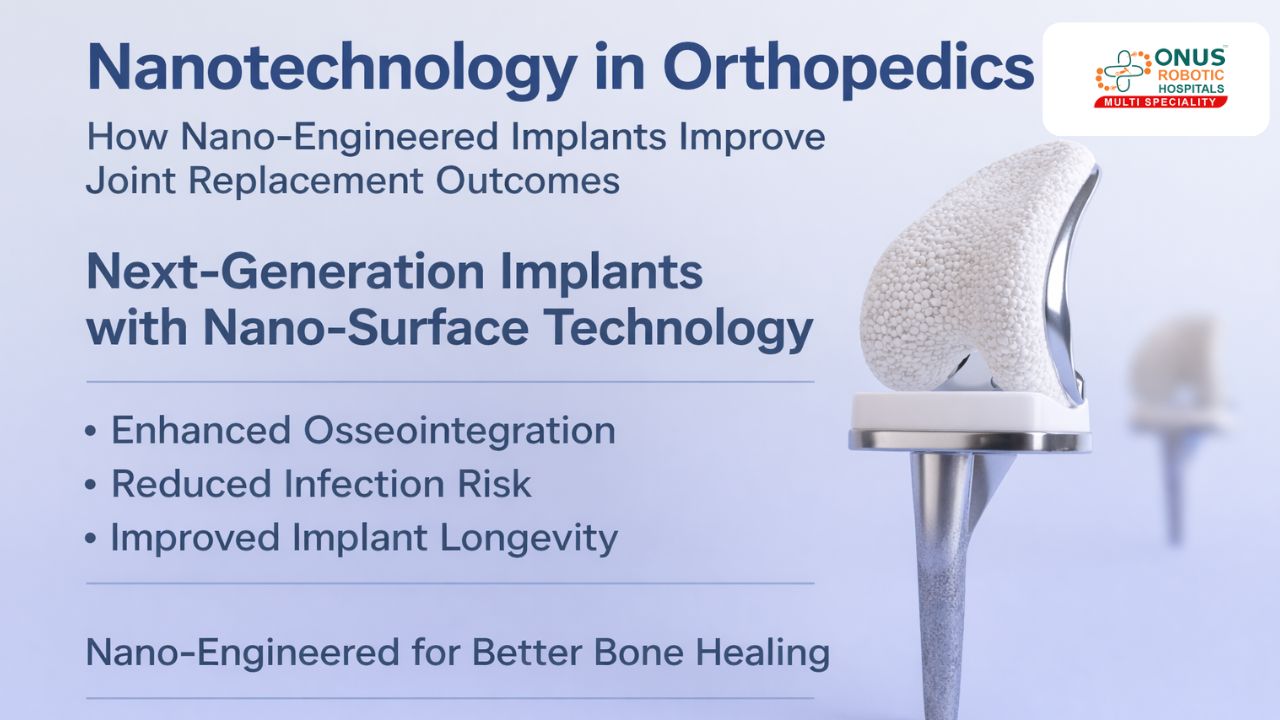
Nanotechnology in Orthopedics: How Nano-Engineered Implants Improve Joint Replacement Outcomes – By Dr. Balaraju Naidu, Robotic Orthopedic Surgeon, ONUS Robotic Hospitals
Introduction: From Mechanical Replacement to Biological Integration
Orthopedic surgery has evolved dramatically over the past few decades. What began as purely mechanical joint replacement has now transitioned into biologically intelligent implant design.
One of the most groundbreaking advancements driving this evolution is nanotechnology in orthopedics.
By engineering implant surfaces at the nanometer scale (1–100 nanometers), modern orthopedic implants can now:
-
Enhance bone bonding
-
Reduce infection risk
-
Improve implant longevity
-
Accelerate healing
-
Mimic natural bone structure
This fusion of biology and material science is redefining long-term outcomes in joint replacement surgery.
What Is Nanotechnology?
A nanometer (nm) is one-billionth of a meter.
At this microscopic scale:
-
Materials behave differently
-
Surface chemistry changes
-
Cellular interactions improve
Interestingly, human bone itself is nano-structured.
Bone contains:
-
Nano-scale collagen fibers
-
Hydroxyapatite crystals
-
Micro and nano surface architecture
Modern implants are now designed to mimic this natural nano-architecture — creating a surface environment that encourages biological integration rather than simple mechanical fixation.
How Nanotechnology Improves Orthopedic Implants
1️⃣ Enhanced Osseointegration (Bone Bonding)
Osseointegration is the direct bonding between bone and implant.
Nano-engineered surfaces:
-
Increase surface roughness at microscopic levels
-
Improve surface energy
-
Promote osteoblast (bone cell) attachment
-
Accelerate bone growth onto implant surfaces
Result:
✔ Faster bone bonding
✔ Improved implant stability
✔ Reduced loosening risk
This is especially important in younger, active patients requiring long-term implant survival.
2️⃣ Reduced Infection Risk
Implant-related infection is one of the most serious complications in orthopedic surgery.
Nanotechnology helps by:
-
Incorporating silver nanoparticles
-
Creating anti-bacterial nano coatings
-
Reducing bacterial adhesion
-
Preventing biofilm formation
Biofilms are protective bacterial layers that make infections difficult to treat.
By reducing bacterial attachment at the nano level, implants become more resistant to infection.
3️⃣ Improved Bone Regeneration
Nano-hydroxyapatite and nano-scaffold technologies are used in:
-
Bone graft substitutes
-
Spine fusion surgery
-
Fracture non-union cases
-
Bone defect reconstruction
These materials:
-
Mimic natural bone mineral
-
Promote cellular signaling
-
Accelerate tissue regeneration
This improves healing in complex orthopedic cases.
4️⃣ Targeted Drug Delivery Systems
Emerging nano-based delivery systems allow:
-
Localized antibiotic release
-
Growth factor delivery
-
Anti-inflammatory agent targeting
Benefits include:
-
Reduced systemic side effects
-
Higher concentration at surgical site
-
Improved healing environment
This represents the future of precision post-surgical care.
Clinical Applications of Nano-Engineered Orthopedic Implants
Nanotechnology is currently used or being researched in:
-
Total Knee Replacement
-
Total Hip Replacement
-
Spine Fusion Surgery
-
Trauma Fixation Devices
-
Bone Defect Reconstruction
-
Dental Implants
In joint replacement specifically, nano-textured titanium and ceramic components enhance integration and durability.
Does Nanotechnology Replace Surgical Skill?
No.
Nanotechnology is an enhancer — not a substitute.
Long-term outcomes still depend on:
-
Proper patient selection
-
Accurate implant alignment
-
Robotic precision systems
-
Meticulous surgical technique
-
Post-operative rehabilitation
Technology improves potential — expertise determines execution.
Limitations of Nanotechnology
Despite its promise, nanotechnology has challenges:
-
Higher manufacturing cost
-
Long-term data still evolving
-
Complex regulatory approvals
-
Variability in nano-coating quality
Clinical evidence continues to grow, but ongoing research is necessary.
The Future of Nano Orthopedics
Research is advancing rapidly toward:
-
Smart implants with embedded nano sensors
-
Self-healing implant coatings
-
Nano-bioactive materials
-
AI-integrated nano surface customization
-
Personalized implant surface design
The ultimate goal:
Implants that interact dynamically with the human body — sensing stress, preventing infection, and promoting healing automatically.
Orthopedics is moving from static implants to intelligent implants.
Why This Matters for Patients
For patients undergoing joint replacement:
Nanotechnology may offer:
✔ Better bone bonding
✔ Lower infection risk
✔ Improved implant lifespan
✔ Faster recovery
✔ Reduced revision surgery risk
When combined with robotic alignment and advanced surgical planning, nano-engineered implants represent the future of precision orthopedics.
Conclusion
Nanotechnology represents the next phase of orthopedic innovation — where biology meets engineering.
By mimicking natural bone architecture at the nano scale, implants are becoming:
-
More compatible
-
More durable
-
More intelligent
-
More reliable
As research progresses, nano-orthopedics will continue shaping the future of joint replacement surgery.
Orthopedic surgery is no longer just mechanical.
It is becoming biological, intelligent, and precision-driven.
For Appointments:
Dr. Balaraju Naidu, Robotic Orthopedic Surgeon
ONUS Robotic Hospitals – Hyderabad
👉 link: contact-us or book-appointment