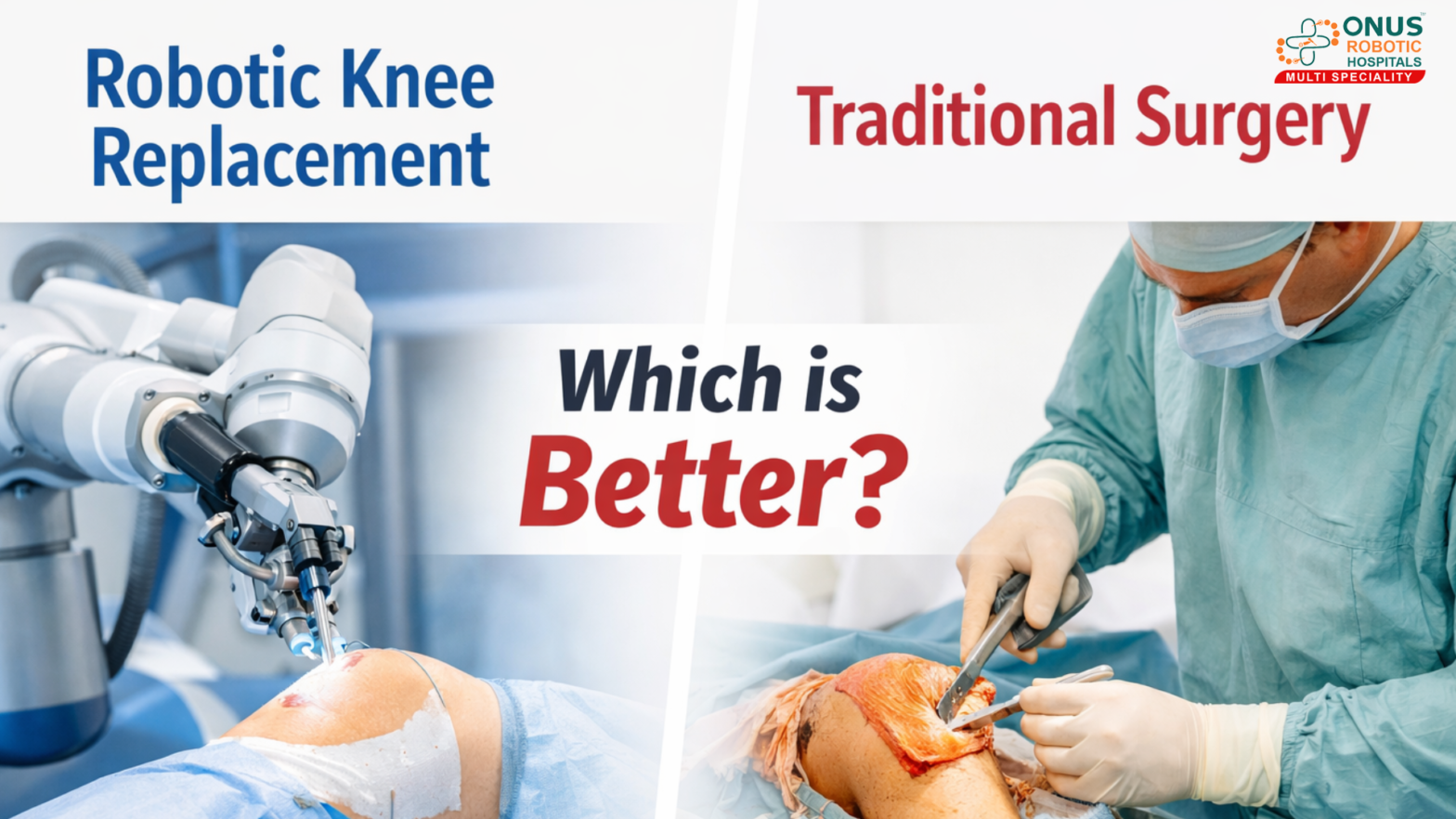
Robotic Knee Replacement vs Traditional Surgery – Complete Guide – By Dr. Balaraju Naidu, Robotic Orthopedic Surgeon, ONUS Robotic Hospitals
Knee replacement surgery has transformed the lives of millions suffering from advanced arthritis. Over the last decade, the introduction of robotic-assisted systems has changed how surgeons plan and execute joint replacement procedures.
But the real question patients ask is:
Is robotic knee replacement truly better than traditional surgery?
Let’s examine this objectively.
Understanding Traditional Knee Replacement
Traditional total knee replacement has been performed successfully for decades. It relies on:
-
Mechanical alignment guides
-
Intramedullary and extramedullary rods
-
Manual bone cuts
-
Surgeon experience and intraoperative judgment
This method has strong long-term data and excellent outcomes when performed by experienced surgeons.
Traditional knee replacement remains a proven, reliable, and globally accepted technique.
What Is Robotic Knee Replacement?
Modern robotic systems such as Mako Robotic-Arm Assisted Surgery System and ROSA Knee System assist surgeons with data-driven precision.
Robotic knee replacement does not mean the robot performs surgery independently. The surgeon remains in control.
The robotic platform provides:
-
CT-based 3D modeling of the patient’s knee
-
Detailed preoperative digital planning
-
Controlled and precise bone resection
-
Real-time ligament and soft tissue assessment
-
Haptic boundary protection to avoid excessive cuts
This enhances surgical accuracy and reduces variability.
Key Differences Between Robotic and Traditional Knee Replacement
| Feature | Traditional Surgery | Robotic Surgery |
|---|---|---|
| Planning | Standard templating | CT-based 3D planning |
| Execution | Manual | Surgeon-controlled robotic assistance |
| Alignment | Mechanical alignment | Personalized alignment possible |
| Precision | Surgeon-dependent | Digitally guided |
| Reproducibility | Variable | Highly consistent |
Robotic systems aim to reduce “alignment outliers,” which are small degrees of misalignment that may influence implant longevity.
Does Precision Translate Into Better Outcomes?
Short- to mid-term research shows:
✔ Improved alignment accuracy
✔ Better soft tissue balancing
✔ Reduced variability
✔ Potential for improved early functional outcomes
However:
-
Long-term survivorship data (15–20 years) is still evolving
-
Implant design and surgical expertise remain crucial factors
-
Robotic assistance does not replace surgical judgment
Precision enhances predictability — but experience ensures safety.
Is Robotic Surgery Superior?
The honest answer:
Robotic surgery enhances precision.
Traditional surgery remains proven and effective.
Robotics is a powerful tool — but it is not a replacement for surgical expertise.
The best outcomes occur when:
Advanced technology supports an experienced orthopedic surgeon.
Who May Benefit More from Robotic Surgery?
Robotic assistance may be particularly helpful in:
-
Severe deformities
-
Complex alignment issues
-
Younger active patients seeking optimized implant positioning
-
Patients requiring personalized joint balancing
But candidacy should be evaluated individually.
Final Verdict
Traditional Knee Replacement
✔ Decades of proven success
✔ Reliable and effective
Robotic Knee Replacement
✔ Enhanced precision
✔ Personalized alignment
✔ Improved reproducibility
The goal is not choosing technology over experience.
The goal is achieving:
-
Pain relief
-
Functional mobility
-
Long-term implant survival
-
Better quality of life
Consult an experienced orthopedic surgeon to determine the most appropriate approach for your condition.
For Appointments:
Dr. Balaraju Naidu, Robotic Orthopedic Surgeon
ONUS Robotic Hospitals – Hyderabad
👉 link: contact-us or book-appointment