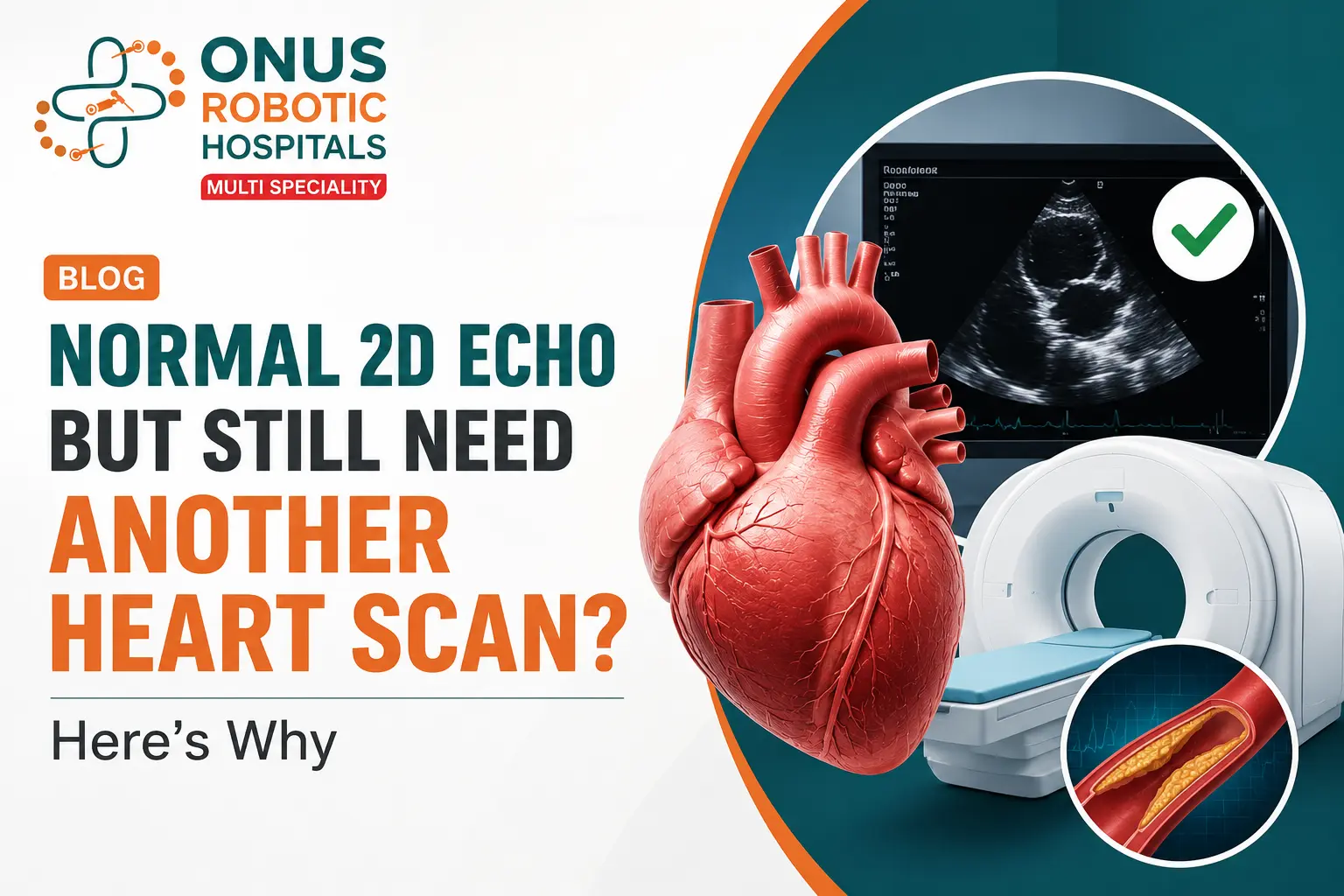
Normal 2D Echo but Still Need Another Heart Scan? Here’s Why- By Cardiologist, ONUS Robotic Hospitals
Normal 2D Echo but Still Need Another Heart Scan? Here’s Why- By Cardiologist, ONUS Robotic Hospitals
Many patients feel confused when their 2D Echo report is normal, but the doctor still suggests another scan like CT Coronary Angio, Stress Test, Cardiac CT, Angiogram, or MRI.
A normal Echo is good news, but it does not always rule out every heart problem. Echo mainly checks the heart’s structure, pumping function, valves, and blood flow. However, some problems, especially coronary artery blockages, may need additional tests depending on symptoms and risk factors.
In this video, Senior Clinical Cardiologist at ONUS Robotic Hospitals, explains why a new scan may be advised even after a normal Echo, when chest pain needs further evaluation, and how doctors decide the right cardiac test.
What Does a 2D Echo Show?
A 2D Echo, or echocardiogram, is an ultrasound scan of the heart. It helps doctors assess heart structure and function without surgery or radiation.
A 2D Echo can show:
Heart pumping function Ejection fraction Heart chamber size Valve opening and closing Valve leakage or narrowing Blood flow through the heart Heart wall movement Fluid around the heart Some congenital heart problems
Mayo Clinic explains that an echocardiogram can show how heart valves open and close, help diagnose valve disease, and show how the heart wall helps pump blood.
Why Can Echo Be Normal Even With Symptoms?
A normal Echo means the heart’s pumping function, valves, and visible structure may look normal at rest. But it does not always show whether the coronary arteries have plaque or narrowing.
For example, a patient may have:
Normal pumping function Normal valves No visible wall motion abnormality at rest But still have coronary artery disease or early blockage
Coronary artery disease may need tests that directly or indirectly assess blood flow to the heart muscle or look at the coronary arteries. Mayo Clinic notes that if symptoms of coronary artery disease such as chest pain or shortness of breath are present, additional tests may be done to check overall heart health.
When CT Coronary Angio Is Advised
CT Coronary Angiography is a non-invasive CT scan used to look at the coronary arteries. It can help detect plaque buildup or narrowing in the heart blood vessels.
Doctors may advise CT Coronary Angio when:
Chest pain is stable Echo is normal but symptoms continue Patient has diabetes, BP, cholesterol, smoking history, or family history ECG is not clearly diagnostic Doctor wants to check coronary arteries non-invasively Risk is low to intermediate but symptoms need evaluation
CT Coronary Angio is commonly used in selected stable chest pain patients to assess coronary artery disease risk and decide whether further treatment or invasive angiography is needed.
When Stress Test Is Needed
A stress test checks how the heart performs during exercise or simulated stress. Some heart problems may not appear when the patient is resting but may become visible when the heart works harder.
A stress test may be advised when:
Chest pain occurs during walking or climbing stairs Breathlessness occurs during exertion ECG and Echo are not enough to explain symptoms Doctor wants to assess exercise-related blood flow changes Functional capacity needs to be checked
Mayo Clinic explains that an exercise stress test can show heart problems that might otherwise be missed because exercise makes the heart pump harder and faster.
When Traditional Angiogram May Be Required
A traditional coronary angiogram is an invasive cath lab procedure. It uses X-rays and contrast dye to directly view coronary arteries. It is usually advised when there is strong suspicion of significant blockage or when treatment like angioplasty and stenting may be required.
Mayo Clinic explains that a coronary angiogram is used to look at the heart’s blood vessels and is often used to diagnose coronary artery disease. During the same procedure, angioplasty and stenting can be done to open blocked arteries.
Traditional angiogram may be needed when:
CT Coronary Angio shows significant narrowing Stress test is strongly positive Troponin is elevated ECG shows ischemic changes Symptoms suggest unstable angina or heart attack Chest pain is severe or recurrent Angioplasty or stenting may be required
Role of ECG, Blood Tests, Echo, CT and Cath Lab
Heart evaluation is not based on one test alone. Cardiologists combine symptoms, risk factors, examination, and test findings.
ECG
ECG checks electrical activity of the heart and can show rhythm problems, heart attack changes, or reduced blood flow patterns.
Blood Tests
Blood tests such as troponin help detect heart muscle injury. Other tests may include sugar, cholesterol, kidney function, and infection markers depending on the case.
2D Echo
Echo checks heart pumping function, valves, wall motion, and structure.
CT Coronary Angio / Cardiac CT
Cardiac CT can show coronary artery plaque, narrowing, calcium, and anatomy in selected patients.
Cath Lab Angiogram
Angiogram directly checks coronary arteries and allows treatment such as angioplasty or stenting when needed.
Chest Pain Warning Signs You Should Not Ignore
Chest pain should not be ignored, even if a previous Echo was normal.
Seek urgent cardiac evaluation if you have:
Chest pain or heaviness Pain spreading to shoulder, arm, neck, jaw, back, or upper abdomen Breathlessness Sweating Dizziness Nausea Unusual fatigue Palpitations Fainting Symptoms during walking or climbing stairs Chest discomfort in a patient with diabetes, BP, cholesterol, or smoking history
Some patients, especially diabetics, elderly patients, and women, may not have typical chest pain. They may present with breathlessness, fatigue, sweating, nausea, or discomfort.
Why Your Doctor May Advise Another Scan After Normal Echo
Your doctor may advise another scan if:
Symptoms continue despite normal Echo Chest pain pattern looks cardiac Risk factors are present ECG has changes Blood tests are abnormal Exercise-related symptoms are present Doctor suspects coronary artery blockage Family history of heart disease is strong Previous cardiac history exists A more detailed artery assessment is needed
A normal Echo is reassuring, but it is only one part of cardiac evaluation.
When Urgent Cardiac Evaluation Is Needed
Do not wait for routine appointment if you have:
Severe chest pain Sweating with chest discomfort Breathlessness at rest Pain spreading to jaw, arm, neck, or back Dizziness or fainting Persistent nausea with chest discomfort Sudden weakness Known heart disease with new symptoms Diabetes with chest heaviness or breathlessness
Emergency care is safer than waiting when heart attack symptoms are possible.
Expert Cardiac Care at ONUS Robotic Hospitals
At ONUS Robotic Hospitals, patients with chest pain, breathlessness, normal Echo but ongoing symptoms, suspected heart blockage, BP, diabetes-related heart risk, and emergency cardiac symptoms receive timely evaluation and personalized care.