Hip and Knee Replacement Centre

Overview

Advanced Joint Replacement for Pain-Free Movement & Long-Term Mobility


About the Centre

The Hip & Knee Replacement Centre at ONUS Robotic Hospitals is dedicated to providing advanced joint reconstruction and replacement solutions for patients suffering from severe joint pain, arthritis, and complex injuries.

We combine expert surgical skills, cutting-edge technology, and structured rehabilitation to deliver predictable, long-term outcomes.


Conditions We Treat

Our specialists manage a wide range of hip and knee conditions, including:

  • Advanced arthritis (knee & hip)
  • Joint degeneration due to aging
  • Post-traumatic joint damage
  • Failed or worn-out joint replacements (revision cases)
  • Complex fractures near joints
  • Bone infections and non-healing fractures

Our Treatment Expertise

Joint Replacement Surgery

  • Total Knee Replacement (TKR)
  • Total Hip Replacement (THR)
  • Partial Knee Replacement

πŸ‘‰ Replaces damaged joint surfaces with high-quality artificial implants to restore pain-free movement


Revision Joint Replacement

  • Replacement of failed or worn-out implants
  • Management of complex cases with precision

Arthroscopic Procedures

  • Minimally invasive (keyhole) surgeries
  • Used for ligament, cartilage, and joint issues

Ilizarov Technique (Advanced Reconstruction)

  • Bone lengthening and deformity correction
  • Used for:
    • Complex fractures
    • Bone defects
    • Limb length discrepancies

Bone Grafting & Joint Reconstruction

  • Restores bone loss and supports implant stability
  • Improves long-term success of joint surgeries

Surgical Techniques & Options

  • Cemented Joint Replacement – immediate fixation
  • Cementless Joint Replacement – long-term biological fixation

πŸ‘‰ Technique is chosen based on age, bone quality, and activity level


Advanced Technology

  • Robotic-assisted joint replacement
  • High-precision surgical planning
  • 1.5 Tesla MRI & 128-slice CT scan
  • Minimally invasive surgical approaches

Rehabilitation & Recovery

Recovery is supported by dedicated physiotherapy and rehabilitation programs:

  • Early mobilization protocols
  • Personalized physiotherapy plans
  • Strength and mobility restoration
  • Long-term follow-up care

πŸ‘‰ Brutal Truth:
Surgery relieves pain β€”
rehabilitation decides how well you move.


Why Choose ONUS Hip & Knee Centre?

  • High-volume joint replacement expertise
  • Advanced robotic and minimally invasive techniques
  • Experienced orthopedic surgeons
  • Personalized patient care and rehabilitation
  • Focus on long-term mobility and quality of life

πŸ‘‰ Our Approach:

We don’t just replace joints β€”
we restore movement, independence, and confidence.


Key Advantages

  • Faster recovery
  • Reduced pain
  • Improved joint function
  • Long-lasting implant performance
  • Return to active lifestyle

Frequently Asked Questions (FAQs)

1. When do I need joint replacement?

When pain is severe, mobility is limited, and non-surgical treatments fail.

2. How long does a joint replacement last?

Modern implants typically last 15–25 years, depending on usage and care.

3. How soon can I walk after surgery?

Most patients start walking within 1–3 days with support.


Book a Consultation

πŸ“ Champapet | Uppal | Tukkuguda
πŸ“ž 1800 103 1956 | 73967 77240
🌐 www.onusrobotichospitals.com

Treatments & Procedures

Hip & Knee Replacement Centre

Treatments & Procedures


Comprehensive Hip & Knee Care

At ONUS Robotic Hospitals, we provide advanced surgical and non-surgical treatments for hip and knee conditions β€” from sports injuries to complex joint replacements.

Our focus is simple:
πŸ‘‰ Relieve pain β†’ Restore function β†’ Improve long-term mobility


ACL Injury (Anterior Cruciate Ligament Tear)

The ACL is a key ligament that stabilizes the knee and prevents excessive rotation.

Common Causes:

  • Sudden twisting movements
  • Sports injuries
  • Knee hyperextension

Symptoms:

  • Instability (giving way)
  • Pain and swelling
  • Difficulty in movement

Treatment:

  • Initial care: Rest, ice, compression, immobilization
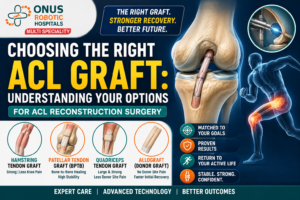
  • Definitive treatment: Arthroscopic ACL reconstruction

πŸ‘‰ Ligament is reconstructed using graft tissue for long-term stability


Hip Fractures

Hip fractures are orthopedic emergencies requiring immediate care.

Common Causes:

  • Falls (especially in elderly)
  • Trauma or accidents
  • Bone weakness (osteoporosis)

Treatment Options:

  • Emergency stabilization
  • Surgical fixation using rods, plates, or screws
  • Bone grafting (if required)
  • Total hip replacement in severe cases

πŸ‘‰ Goal: Restore mobility and prevent complications


Total Hip Replacement (THR)

A highly effective solution for:

  • Advanced arthritis
  • Severe joint damage
  • Chronic hip pain

Procedure:

  • Damaged hip joint is replaced with an artificial implant
  • Restores smooth, pain-free movement

πŸ‘‰ Best option when conservative treatment fails


Hip Revision Surgery

Performed when a previous hip replacement fails due to:

  • Wear and tear
  • Infection
  • Implant loosening

Objective:

  • Replace or repair the artificial joint
  • Restore normal hip function

Knee Arthroscopy

A minimally invasive (keyhole) procedure used to:

  • Diagnose joint problems
  • Treat ligament and cartilage injuries

Common Uses:

  • Meniscus tear repair
  • Cartilage smoothing
  • Removal of loose bodies

πŸ‘‰ Provides faster recovery and less pain compared to open surgery


Total Knee Replacement (TKR)

Indicated in:

  • Advanced or end-stage arthritis
  • Severe deformity
  • Chronic pain not responding to treatment

Procedure:

  • Damaged cartilage and bone are replaced
  • Artificial knee implant restores movement

πŸ‘‰ Enables pain-free walking and improved quality of life


Advanced Procedures We Offer

Our expert team also performs:

  • Meniscal repair
  • Chondral (cartilage) grafting
  • Cruciate ligament reconstruction (ACL/PCL)
  • Complex multi-ligament reconstruction
  • Knee osteotomy (joint preservation surgery)
  • Management of soft tissue injuries (hip & knee)

Technology & Surgical Excellence

  • Robotic-assisted joint replacement
  • Arthroscopic (minimally invasive) techniques
  • High-precision imaging (MRI, CT)
  • Advanced implant systems

Rehabilitation & Recovery

Recovery is supported through:

  • Early mobilization protocols
  • Structured physiotherapy programs
  • Strength and mobility training
  • Long-term follow-up care

πŸ‘‰ Brutal Truth:

Surgery fixes the joint β€”
rehabilitation determines how well you use it.


Why Choose ONUS Hip & Knee Centre?

  • High-volume joint replacement expertise
  • Fellowship-trained orthopedic surgeons
  • Advanced minimally invasive techniques
  • Personalized treatment plans
  • Strong rehabilitation support

πŸ‘‰ Our Approach:

We don’t just treat joints β€”
we restore movement, independence, and performance.


Book a Consultation

πŸ“ Champapet | Uppal | Tukkuguda
πŸ“ž 1800 103 1956 | 73967 77240
🌐 www.onusrobotichospitals.com
Achievements

Achievements


At ONUS Robotic Hospitals, our Hip & Knee Centre is built on a multidisciplinary, patient-centric approach to ensure the best surgical outcomes and long-term recovery.


Key Achievement

  • Comprehensive Multidisciplinary Care Model
    Every patient undergoes a structured treatment pathway that includes:
    • Initial expert assessment by orthopedic specialists
    • Pre-operative optimization to improve surgical safety and outcomes
    • Post-operative follow-up and rehabilitation for long-term success

πŸ‘‰ What This Means for You:

  • Safer surgeries with reduced complications
  • Better surgical planning and precision
  • Faster recovery and improved mobility
  • Continuous care throughout your treatment journey

πŸ‘‰ Our Commitment:

We don’t treat surgery as a single event β€”
we manage the entire patient journey from diagnosis to full recovery.

Technology

Technology


At ONUS Robotic Hospitals, we utilize advanced minimally invasive and precision-driven surgical techniques to ensure faster recovery, less pain, and superior outcomes in joint replacement procedures.


Advanced Surgical Technologies

Mini-Incision Hip Replacement

  • Performed through smaller surgical cuts compared to traditional methods
  • Less muscle damage and blood loss
  • Faster recovery and shorter hospital stay

πŸ‘‰ Enables patients to regain mobility quickly with minimal scarring


Mini-Incision Total Knee Arthroplasty (TKA)

  • Knee replacement performed using smaller incisions
  • Preserves surrounding soft tissues
  • Reduces post-operative pain

πŸ‘‰ Ideal for faster rehabilitation and early return to daily activities


Quad-Sparing Total Knee Replacement

  • Advanced technique that avoids cutting the quadriceps muscle
  • Maintains muscle strength
  • Improves early mobility and function

πŸ‘‰ Results in quicker recovery and better knee control post-surgery


πŸ‘‰ Technology Advantage:

Less tissue damage + precise techniques =
faster healing, better function, and long-term implant success


πŸ‘‰ Our Approach:

We combine modern surgical innovations with expert execution to deliver
pain-free movement and optimal recovery for every patient

Hip Replacement Cost

Hip Replacement Surgery Cost

Advanced Joint Replacement for Pain-Free Living


What is Hip Replacement Surgery?

Hip replacement (Hip Arthroplasty) is a surgical procedure in which the damaged parts of the hip joint are replaced with artificial implants made of metal, ceramic, or high-grade plastic.

This helps to:

  • Relieve severe hip pain
  • Restore joint movement
  • Improve quality of life

πŸ‘‰ Simple Understanding:
When the hip joint is worn out β€”
we replace it with a new, smooth, functional joint


Hip Replacement Cost in Hyderabad

πŸ’° Estimated Cost:

  • β‚Ή2,50,000 – β‚Ή3,55,000 (standard procedures)
  • β‚Ή3,00,000 – β‚Ή4,55,000 (premium implants & advanced care)

πŸ‘‰ Cost varies depending on hospital, technology, and patient condition


Factors Affecting Cost

The total cost depends on:

  • Type of implant (ceramic, metal, hybrid)
  • Surgeon expertise
  • Hospital infrastructure
  • Use of advanced techniques (robotic/minimally invasive)
  • Pre-operative tests and imaging
  • Post-operative rehabilitation and stay

πŸ‘‰ Reality Check:

Cheaper surgery may compromise implant quality, precision, or rehab support


When Do You Need Hip Replacement?

Hip replacement is recommended when:

  • Severe hip pain limits daily activities
  • Pain persists despite medication
  • Joint stiffness restricts movement
  • Conservative treatment fails

Common Conditions:

  • Osteoarthritis (wear and tear)
  • Rheumatoid arthritis (autoimmune damage)
  • Osteonecrosis (loss of blood supply to bone)

πŸ‘‰ These conditions damage cartilage and lead to bone-on-bone pain


Types of Hip Replacement

  • Total Hip Replacement (THR) – Entire joint replaced
  • Partial Hip Replacement – Only damaged part replaced
  • Bilateral Hip Replacement – Both hips replaced

Implant Longevity

  • Modern implants typically last 15–25 years
  • Depends on activity level, weight, and lifestyle

πŸ‘‰ With proper care, long-term results are highly successful


Benefits of Hip Replacement

  • Significant pain relief
  • Improved mobility and flexibility
  • Better quality of life
  • Return to normal activities

Risks & Complications

Though uncommon, risks include:

  • Infection
  • Blood clots
  • Dislocation
  • Leg length difference
  • Nerve injury

Recovery After Hip Replacement

Timeline:

  • Walking: 1–3 days
  • Basic recovery: 2–4 weeks
  • Full recovery: 6–12 weeks

πŸ‘‰ Early mobilization + physiotherapy = faster recovery


Why Choose ONUS Robotic Hospitals?

  • Expertise in advanced hip replacement surgeries
  • High-quality implants and precision techniques
  • Advanced imaging (MRI, CT) for planning
  • Strong rehabilitation and follow-up care

πŸ‘‰ Our Approach:

We don’t just replace joints β€”
we restore pain-free movement and long-term function


Frequently Asked Questions (FAQs)

1. What is the cost of hip replacement in India?

Typically ranges from β‚Ή2.3–3.5 lakhs for single hip replacement.

2. How long does recovery take?

Most patients recover in 2–4 weeks, with full recovery over a few months.

3. Is hip replacement safe?

Yes. It is a highly successful procedure with excellent long-term outcomes.


Book a Consultation

πŸ“ Champapet | Uppal | Tukkuguda
πŸ“ž 1800 103 1956 | 73967 77240
🌐 www.onusrobotichospitals.com
Knee Replacement Cost

Advanced Treatment for Pain-Free Walking & Active Living


What is Knee Replacement Surgery?

Knee replacement (Knee Arthroplasty) is a surgical procedure in which the damaged parts of the knee joint are replaced with artificial implants.

These implants (prosthetics), made of metal and high-grade plastic, help:

  • Reduce severe knee pain
  • Restore joint movement
  • Improve walking ability and quality of life

πŸ‘‰ Simple Understanding:

When the knee joint is worn out β€”
we replace it with a smooth, functional artificial joint


Knee Replacement Cost in Hyderabad

πŸ’° Estimated Cost:

  • β‚Ή2,30,000 – β‚Ή5,50,000

πŸ‘‰ Cost varies depending on hospital, technology, and patient condition


Factors Affecting Cost

The total cost depends on:

  • Type of implant used
  • Surgical technique (robotic / minimally invasive / open)
  • Surgeon expertise
  • Hospital infrastructure
  • Pre-operative investigations
  • Post-operative rehabilitation

πŸ‘‰ Reality Check:

Lower cost may compromise implant quality, surgical precision, or rehab support


When Do You Need Knee Replacement?

Knee replacement is recommended when:

  • Severe knee pain limits daily activities
  • Difficulty in walking, climbing stairs, or standing
  • Pain not relieved by medications or injections
  • Joint stiffness and deformity

Common Conditions:

  • Osteoarthritis (most common)
  • Rheumatoid arthritis
  • Post-traumatic arthritis (after injury)
  • Knee deformities (bow legs, knock knees)

πŸ‘‰ These conditions cause cartilage damage leading to bone-on-bone pain


Types of Knee Replacement

  • Total Knee Replacement (TKR)
  • Partial Knee Replacement
  • Robotic Knee Replacement
  • Minimally Invasive Knee Surgery

πŸ‘‰ Procedure type influences both cost and recovery outcomes


Implant Longevity

  • Modern knee implants last 15–20 years
  • Depends on patient activity, weight, and lifestyle

πŸ‘‰ With proper care, long-term results are highly successful


Benefits of Knee Replacement

  • Significant pain relief
  • Improved mobility and flexibility
  • Better quality of life
  • Return to daily activities

Risks & Complications

Though uncommon, risks include:

  • Infection
  • Blood clots
  • Implant loosening
  • Knee stiffness
  • Nerve injury

Recovery After Knee Replacement

Timeline:

  • Walking: 1–3 days
  • Basic recovery: 4–6 weeks
  • Full recovery: 3–6 months
  • Complete functional recovery: up to 12 months

πŸ‘‰ Early physiotherapy is critical for best results


Why Choose ONUS Robotic Hospitals?

  • Expertise in robotic and advanced knee replacement
  • High-quality implants and precision techniques
  • Advanced imaging (MRI, CT) for surgical planning
  • Strong physiotherapy and rehabilitation support

πŸ‘‰ Our Approach:

We don’t just replace knees β€”
we restore pain-free walking and active lifestyle


Frequently Asked Questions (FAQs)

1. What is the cost of knee replacement in India?

Typically ranges from β‚Ή2.3 lakhs to β‚Ή5.5 lakhs, depending on multiple factors.

2. How long does recovery take?

Basic recovery takes 4–6 weeks, while full recovery may take 3–6 months.

3. Is knee replacement a major surgery?

Yes, it is a major procedure β€” but highly successful with modern techniques.


Book a Consultation

πŸ“ Champapet | Uppal | Tukkuguda
πŸ“ž 1800 103 1956 | 73967 77240
🌐 www.onusrobotichospitals.com

Knee Arthroscopy Surgery Cost

Minimally Invasive Solution for Knee Pain & Faster Recovery


What is Knee Arthroscopy?

Knee arthroscopy is a minimally invasive (keyhole) procedure used to diagnose and treat knee joint problems.

It is commonly performed as a day-care surgery, allowing patients to go home the same day.

πŸ‘‰ Procedure Overview:

  • Small incisions are made around the knee
  • A tiny camera (arthroscope) is inserted
  • Surgeon views the joint on a screen
  • Damaged tissue is treated with precision

πŸ‘‰ Outcome: Less pain, faster recovery, minimal scarring


Knee Arthroscopy Cost in Hyderabad

πŸ’° Estimated Cost:

β‚Ή1,00,000 – β‚Ή1,50,000

πŸ‘‰ Cost may vary depending on hospital, surgeon, and procedure complexity


Factors Affecting Cost

  • Type of procedure (meniscus repair, ACL, cartilage work)
  • Surgeon expertise
  • Hospital infrastructure
  • Arthroscopy equipment and technology
  • Anesthesia and OT charges
  • Rehabilitation and follow-up care

πŸ‘‰ Reality Check:

Lower cost often compromises technology, precision, or rehab quality


When is Knee Arthroscopy Needed?

Knee arthroscopy is recommended for:

  • Persistent knee pain
  • Meniscus (cartilage) tear
  • Ligament injuries (ACL, PCL)
  • Joint swelling or stiffness
  • Loose fragments inside joint
  • Cartilage damage

Common Arthroscopic Procedures

  • Meniscus trimming or repair
  • ACL reconstruction
  • Cartilage restoration (microfracture)
  • Removal of loose bodies
  • Plica removal (plica syndrome)
  • Kneecap realignment procedures

How is Knee Arthroscopy Performed?

  • Performed under local, regional, or general anesthesia
  • Small incisions made around the knee
  • Saline fluid is used to expand the joint
  • Arthroscope inserted for visualization
  • Surgical instruments used to treat the problem

⏱️ Duration: 30–60 minutes
πŸ₯ Hospital Stay: Same-day discharge


Recovery After Knee Arthroscopy

Recovery Timeline:

  • Walking: 1–2 weeks
  • Light activities: 3–4 weeks
  • Sports: 6–12 weeks

πŸ‘‰ Recovery is faster compared to open surgery


Benefits of Knee Arthroscopy

  • Minimally invasive
  • Less pain
  • Faster healing
  • Early return to daily activities
  • Minimal blood loss

Risks & Complications

Though uncommon, risks include:

  • Blood clots
  • Joint stiffness
  • Infection
  • Bleeding inside joint

Precautions Before Surgery

  • Inform doctor about medications
  • Avoid eating or drinking as advised
  • Wear comfortable clothing
  • Follow pre-operative instructions carefully

Insurance & Cost Support

  • Most health insurance plans cover arthroscopy procedures
  • Financial planning and guidance available

Why Choose ONUS Robotic Hospitals?

  • Expertise in arthroscopic knee surgeries
  • Advanced imaging (MRI, CT) for accurate diagnosis
  • Minimally invasive, precision-driven techniques
  • Structured rehabilitation programs

πŸ‘‰ Our Approach:

We don’t just treat knee problems β€”
we restore pain-free movement and active lifestyle


Frequently Asked Questions (FAQs)

1. Is knee arthroscopy a major surgery?

No, it is a minimally invasive procedure with faster recovery.

2. How long does recovery take?

Most patients recover within 4–6 weeks, depending on the procedure.

3. Can I go home the same day?

Yes, in most cases, it is a day-care surgery.


Book a Consultation

πŸ“ Champapet | Uppal | Tukkuguda
πŸ“ž 1800 103 1956 | 73967 77240
🌐 www.onusrobotichospitals.com

Knee Osteotomy Surgery Cost

Realign the Knee, Preserve the Joint, Delay Replacement


What is Knee Osteotomy?

Knee osteotomy is a joint-preserving surgical procedure used to treat early arthritis and knee misalignment.

It works by:

  • Cutting and reshaping the bone
  • Shifting body weight away from the damaged part of the knee
  • Reducing pressure on worn-out cartilage

πŸ‘‰ Simple Understanding:

Instead of replacing the knee β€”
we realign it to reduce pain and extend its life


Knee Osteotomy Cost in Hyderabad

πŸ’° Estimated Cost:

  • β‚Ή1,70,000 – β‚Ή3,00,000 (High Tibial Osteotomy – HTO)
  • Up to β‚Ή5,00,000 depending on complexity

πŸ‘‰ Cost varies based on technique, implants, and hospital infrastructure


Factors Affecting Cost

  • Type of osteotomy (HTO, femoral, PFO)
  • Surgical complexity
  • Implants (plates, screws, grafts)
  • Surgeon expertise
  • Hospital infrastructure
  • Rehabilitation requirements

πŸ‘‰ Reality Check:

Lower cost may compromise precision, fixation quality, or rehab support


Types of Knee Osteotomy

1. High Tibial Osteotomy (HTO)

  • Most common procedure
  • Realigns shinbone (tibia)
  • Shifts load away from damaged cartilage

2. Femoral Osteotomy

  • Realigns thighbone (femur)
  • Used in specific deformities

3. Proximal Fibular Osteotomy (PFO)

  • Minimally invasive alternative
  • Simpler and cost-effective in selected cases

Who Needs Knee Osteotomy?

Ideal for:

  • Patients below 60 years
  • Early-stage knee arthritis
  • Bow legs / uneven load distribution
  • Active individuals wanting to delay joint replacement

πŸ‘‰ Brutal Truth:

Done at the right time β€”
can delay knee replacement by 10–15 years


How is Knee Osteotomy Performed?

  • Performed under general or spinal anesthesia
  • Bone (tibia or femur) is cut and reshaped
  • Alignment corrected by:
    • Opening wedge osteotomy (gap created and filled with bone graft)
    • Closing wedge osteotomy (bone wedge removed and fixed)
  • Stabilized using plates and screws

πŸ‘‰ Over time, bone heals in the new alignment


Recovery After Knee Osteotomy

Timeline:

  • Initial healing: 6–8 weeks
  • Full recovery: 3–6 months

Rehabilitation Includes:

  • Physiotherapy for strength and mobility
  • Gradual weight-bearing
  • Use of brace if required

πŸ‘‰ Reality Check:

Recovery is slower than arthroscopy β€”
but benefit is joint preservation


Benefits of Knee Osteotomy

  • Preserves natural knee joint
  • Reduces pain significantly
  • Improves alignment and function
  • Delays or avoids joint replacement
  • Suitable for younger, active patients

Risks & Complications

Though uncommon, risks include:

  • Infection
  • Blood clots
  • Nerve or vessel injury
  • Non-union (bone not healing)
  • Persistent pain

Why Choose ONUS Robotic Hospitals?

  • Expertise in joint preservation surgeries
  • Advanced imaging (MRI, CT) for precise planning
  • High-precision surgical techniques
  • Strong rehabilitation and follow-up care

πŸ‘‰ Our Approach:

We don’t rush into replacement β€”
we focus on saving your natural joint whenever possible


Frequently Asked Questions (FAQs)

1. Is knee osteotomy a major surgery?

Yes, it involves cutting and realigning bone β€” but it offers long-term benefits.

2. How long does recovery take?

Typically 3–6 months, depending on rehab and healing.

3. Is osteotomy better than knee replacement?

For younger patients with early arthritis β€” yes, it preserves the joint


Book a Consultation

πŸ“ Champapet | Uppal | Tukkuguda
πŸ“ž 1800 103 1956 | 73967 77240
🌐 www.onusrobotichospitals.com

Arthroplasty Surgery Cost

Advanced Joint Replacement for Pain-Free Movement & Better Quality of Life


What is Arthroplasty Surgery?

Arthroplasty (Joint Replacement Surgery) is a procedure performed to restore joint function and relieve pain by replacing a damaged joint with an artificial implant.

It is commonly performed on:

  • Knee
  • Hip
  • Shoulder
  • Ankle
  • Elbow

πŸ‘‰ Simple Understanding:

When a joint is worn out and painful β€”
we replace it with a new, smooth, functional joint


Arthroplasty Surgery Cost in Hyderabad

πŸ’° Estimated Cost:

  • β‚Ή1,50,000 – β‚Ή3,00,000 (standard procedures)
  • β‚Ή2,50,000 – β‚Ή5,50,000+ (advanced implants & techniques)

πŸ‘‰ Cost varies based on joint, implant, and surgical complexity


Factors Affecting Cost

  • Type of joint replaced (knee, hip, shoulder, etc.)
  • Implant type (standard vs premium)
  • Surgical technique (robotic / minimally invasive)
  • Surgeon expertise
  • Hospital infrastructure
  • Room category and hospital stay
  • Rehabilitation and physiotherapy

πŸ‘‰ Reality Check:

Lower cost may compromise implant quality, precision, or post-op care


When is Arthroplasty Needed?

Arthroplasty is considered when:

  • Severe joint pain limits daily activities
  • Joint stiffness reduces movement
  • Medications and physiotherapy fail
  • Advanced arthritis or joint damage

πŸ‘‰ Brutal Truth:

Arthroplasty is the last option β€”
used only when conservative treatments no longer work


What Happens During Arthroplasty Surgery?

  • Performed under general or regional anesthesia
  • Incision made over the affected joint
  • Damaged cartilage and bone removed
  • Artificial joint (prosthesis) implanted
  • Joint alignment and movement restored

⏱️ Duration: ~1.5–2 hours (varies by joint)


Hospital Stay & Recovery

  • Initial monitoring in recovery room
  • Hospital stay: 2–5 days (average)
  • Early physiotherapy starts within 24–48 hours

Recovery Timeline:

  • Walking: 1–3 days
  • Basic recovery: 4–6 weeks
  • Full recovery: 3–6 months

πŸ‘‰ Rehabilitation is essential for optimal outcomes


Benefits of Arthroplasty

  • Significant pain relief
  • Improved joint mobility
  • Better quality of life
  • Return to daily activities
  • Long-lasting results

Risks & Complications

Though uncommon, risks include:

  • Infection
  • Blood clots
  • Implant loosening or dislocation
  • Joint stiffness
  • Nerve injury

⚠️ Higher risk in patients with diabetes, heart disease, or low immunity


Why Choose ONUS Robotic Hospitals?

  • Expertise in advanced joint replacement surgeries
  • High-quality implants and precision techniques
  • Robotic and minimally invasive options
  • Advanced imaging (MRI, CT) for surgical planning
  • Strong physiotherapy and rehabilitation support

πŸ‘‰ Our Approach:

We don’t just replace joints β€”
we restore pain-free movement and long-term function


Frequently Asked Questions (FAQs)

1. How long does arthroplasty surgery take?

Typically 1.5 to 2 hours, depending on the joint involved.

2. Is arthroplasty a major surgery?

Yes, but it is highly successful with modern techniques.

3. How long do implants last?

Most implants last 15–25 years, depending on usage and care.


Book a Consultation

πŸ“ Champapet | Uppal | Tukkuguda
πŸ“ž 1800 103 1956 | 73967 77240
🌐 www.onusrobotichospitals.com

Femoral Neck Fracture Cost

Emergency Hip Fracture Treatment for Pain Relief & Mobility Restoration


What is a Femoral Neck Fracture?

A femoral neck fracture is a type of hip fracture that occurs just below the ball (head) of the thigh bone (femur).

This area is critical because it:

  • Connects the ball to the rest of the femur
  • Supports weight-bearing and movement
  • Has limited blood supply (important for healing)

πŸ‘‰ Simple Understanding:

The β€œneck” of the hip bone breaks β€”
separating the ball from the rest of the bone


Why is It Serious?

Femoral neck fractures are considered orthopedic emergencies because:

  • Blood supply to the bone may be disrupted
  • Risk of bone death (avascular necrosis)
  • Severe pain and inability to walk

πŸ‘‰ Brutal Truth:

Delay in treatment =
higher risk of permanent disability or complications


Femoral Neck Fracture Surgery Cost in Hyderabad

πŸ’° Estimated Cost:

  • β‚Ή1,50,000 – β‚Ή3,50,000 (basic procedures)
  • β‚Ή2,50,000 – β‚Ή5,50,000+ (joint replacement cases)

πŸ‘‰ Cost varies depending on fracture type and treatment method


Factors Affecting Cost

  • Type of surgery (fixation vs replacement)
  • Severity and location of fracture
  • Patient age and bone quality
  • Implant type (screws, plates, prosthesis)
  • Surgeon expertise
  • Hospital infrastructure and ICU care
  • Rehabilitation and hospital stay

πŸ‘‰ Reality Check:

Lower cost may compromise implant quality or surgical precision


Diagnosis

  • Clinical examination
  • X-ray (primary test)
  • MRI / CT scan (if needed for detailed evaluation)

πŸ‘‰ Early diagnosis ensures better outcomes and faster recovery


Treatment Options

1. Internal Fixation

  • Screws or plates used to stabilize bone
  • Preferred in younger patients
  • Preserves natural hip joint

2. Partial Hip Replacement

  • Femoral head replaced with prosthesis
  • Suitable for elderly or poor bone quality

3. Total Hip Replacement (THR)

  • Both ball and socket replaced
  • Best option for:
    • Severe fractures
    • Active elderly patients

πŸ‘‰ Offers better long-term mobility and reduced re-surgery risk


Non-Surgical Support (Temporary Only)

  • Pain medications (NSAIDs, opioids)
  • Bed rest and immobilization

πŸ‘‰ These provide relief β€” but do not fix the fracture


Recovery & Rehabilitation

Timeline:

  • Walking: 2–5 days (with support)
  • Basic recovery: 4–8 weeks
  • Full recovery: 3–6 months

Rehabilitation Includes:

  • Physiotherapy for strength and mobility
  • Balance and gait training
  • Osteoporosis management (to prevent future fractures)

Risks & Complications

Though uncommon, risks include:

  • Infection
  • Blood clots
  • Non-union (failure to heal)
  • Avascular necrosis (bone death)
  • Implant complications

Why Choose ONUS Robotic Hospitals?

  • Expertise in hip fracture and joint replacement surgeries
  • Advanced imaging (MRI, CT) for accurate diagnosis
  • Precision-driven surgical techniques
  • Strong rehabilitation and post-operative care

πŸ‘‰ Our Approach:

We don’t just fix fractures β€”
we restore mobility, independence, and long-term function


Frequently Asked Questions (FAQs)

1. What is a subcapital femoral neck fracture?

It is a fracture just below the head of the femur β€” the most common intracapsular hip fracture.

2. What is a femoral neck stress fracture?

A fracture caused by repetitive stress rather than sudden trauma.

3. Is surgery always required?

In most cases, yes β€” especially in displaced fractures.


Book a Consultation

πŸ“ Champapet | Uppal | Tukkuguda
πŸ“ž 1800 103 1956 | 73967 77240
🌐 www.onusrobotichospitals.com

Expert Team of Doctors

Dr. M BALARAJU NAIDU

Dr. M BALARAJU NAIDU

Blogs