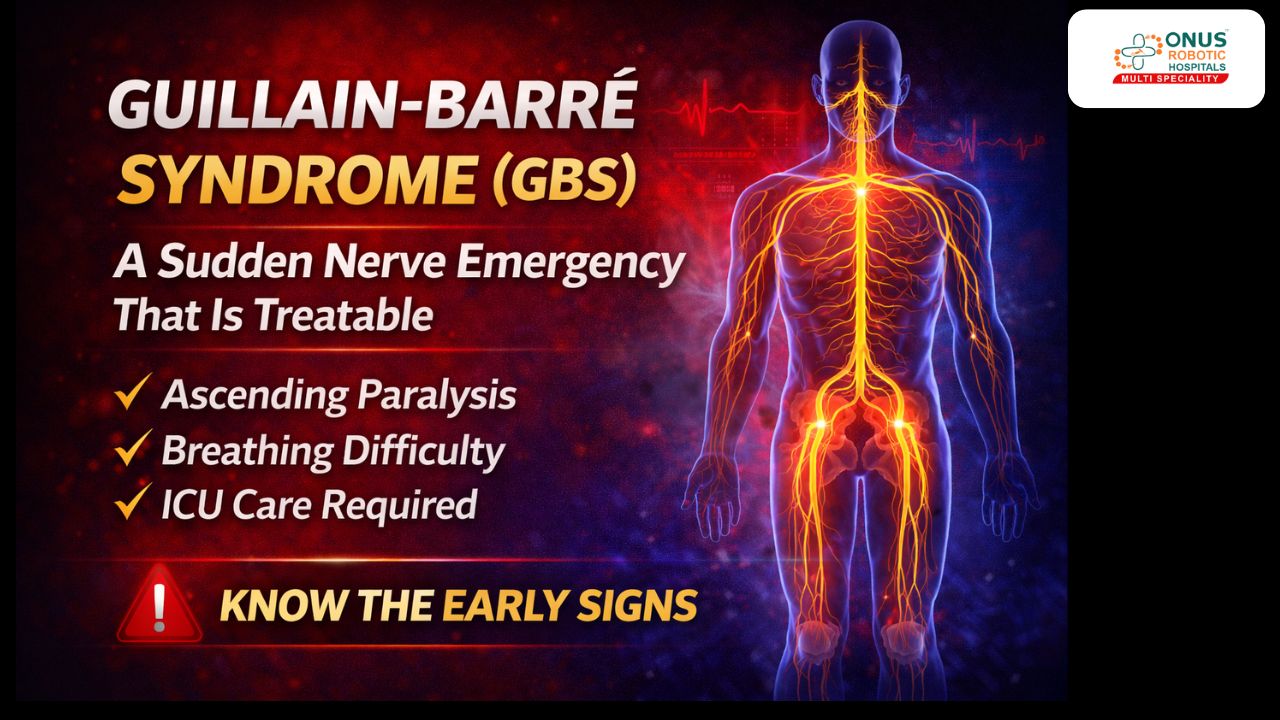
Guillain-Barré Syndrome (GBS): A Sudden Nerve Emergency That Is Treatable – By Dr.Krishna Chaithanya Reddy, Neurologist, ONUS Robotic Hospitals
Introduction
Imagine recovering from a mild viral fever or a simple episode of diarrhea… and within days you notice weakness in your legs. Climbing stairs becomes difficult. Walking feels unstable. The weakness gradually moves upward.
This alarming condition may be Guillain-Barré Syndrome (GBS) — a rapidly progressive neurological emergency that requires immediate medical attention.
Although uncommon, GBS is potentially reversible when recognized and treated early.
Awareness is critical.
What Is Guillain-Barré Syndrome?
Guillain-Barré Syndrome is an autoimmune disorder in which the body’s immune system mistakenly attacks the peripheral nerves.
Peripheral nerves control:
-
Muscle movement
-
Sensation (touch, pain, temperature)
-
Autonomic functions (heart rate, blood pressure)
In GBS:
-
Inflammation damages the myelin sheath (nerve covering)
-
Sometimes nerve fibers themselves are injured
-
Signal transmission between brain and muscles is disrupted
This leads to progressive weakness and sensory disturbances.
Why Does GBS Occur?
In most cases, GBS develops 1–3 weeks after an infection, such as:
-
Viral fever
-
Upper respiratory infection
-
Gastroenteritis (diarrhea)
-
Occasionally after surgery or vaccination (rare)
The underlying mechanism involves molecular mimicry:
The immune system fights infection but mistakenly attacks nerve components due to structural similarity.
Important:
👉 GBS is NOT contagious.
👉 It is an immune-mediated reaction.
Early Symptoms: What to Watch For
The hallmark feature of GBS is:
🔹 Progressive Weakness
-
Begins in the legs
-
Difficulty climbing stairs
-
Trouble standing from a seated position
-
Unsteady walking
Over days, weakness may:
-
Spread to arms
-
Affect facial muscles
-
Involve speech and swallowing
This pattern is known as ascending paralysis.
🔹 Sensory Symptoms
-
Tingling (pins and needles)
-
Numbness
-
Burning or aching pain
Pain can sometimes be severe and precede weakness.
🔹 Severe Symptoms (Medical Emergency)
-
Difficulty breathing
-
Inability to swallow
-
Rapidly worsening weakness
-
Irregular heart rate
-
Blood pressure fluctuations
Approximately 20–30% of patients may require ICU care due to respiratory involvement.
This is why GBS must be treated as an emergency.
Is It a Stroke?
A common misconception is that sudden weakness equals stroke.
Key differences:
| Stroke | Guillain-Barré Syndrome |
|---|---|
| Usually affects one side | Symmetrical weakness |
| Brain involvement | Peripheral nerve involvement |
| Sudden focal deficit | Progressive ascending weakness |
Correct diagnosis is critical because management differs completely.
How Is GBS Diagnosed?
Diagnosis is primarily clinical and supported by:
-
Detailed neurological examination
-
Nerve conduction studies (NCS)
-
Cerebrospinal fluid (CSF) analysis
Early neurologist consultation is essential if progressive weakness is suspected.
Treatment Options
The good news:
GBS is treatable.
Two primary treatments are available:
1️⃣ Intravenous Immunoglobulin (IVIG)
-
Blocks harmful antibodies
-
Reduces immune attack on nerves
-
Given over 5 days
2️⃣ Plasma Exchange (Plasmapheresis)
-
Removes damaging antibodies from blood
-
Reduces severity and duration
Both treatments are equally effective when started early.
Supportive Care Is Critical
-
ICU monitoring
-
Ventilator support (if needed)
-
Blood pressure monitoring
-
Prevention of blood clots
-
Early physiotherapy
Multidisciplinary care improves survival and recovery.
Recovery and Prognosis
Most patients:
-
Begin recovery within weeks
-
Improve gradually over months
-
Recover fully or near fully
Some may experience:
-
Mild residual weakness
-
Fatigue
-
Neuropathic pain
Early treatment significantly improves outcomes.
Recovery requires patience and structured rehabilitation.
When Should You Seek Emergency Care?
Seek urgent medical attention if:
-
Weakness is progressing over hours or days
-
Weakness is moving upward
-
Breathing becomes difficult
-
Swallowing becomes impaired
-
There is sudden inability to walk
Do not ignore progressive weakness, especially after a recent infection.
Key Takeaways
✔ GBS is an autoimmune nerve disorder
✔ Often follows infection
✔ Causes ascending weakness
✔ Can affect breathing
✔ It is a medical emergency
✔ Early treatment saves lives
✔ Most patients recover
Final Message
A simple fever should not lead to paralysis — but in rare cases, it can.
Recognizing early signs of Guillain-Barré Syndrome can prevent life-threatening complications.
Awareness leads to early diagnosis.
Early diagnosis leads to recovery.
If sudden progressive weakness develops — consult a neurologist immediately.
Time matters.
For Appointments:
Dr. Krishna Chaithanya Reddy
Consultant – Interventional Neurologist
ONUS Robotic Hospitals – Hyderabad
👉 link: contact-us or book-appointment