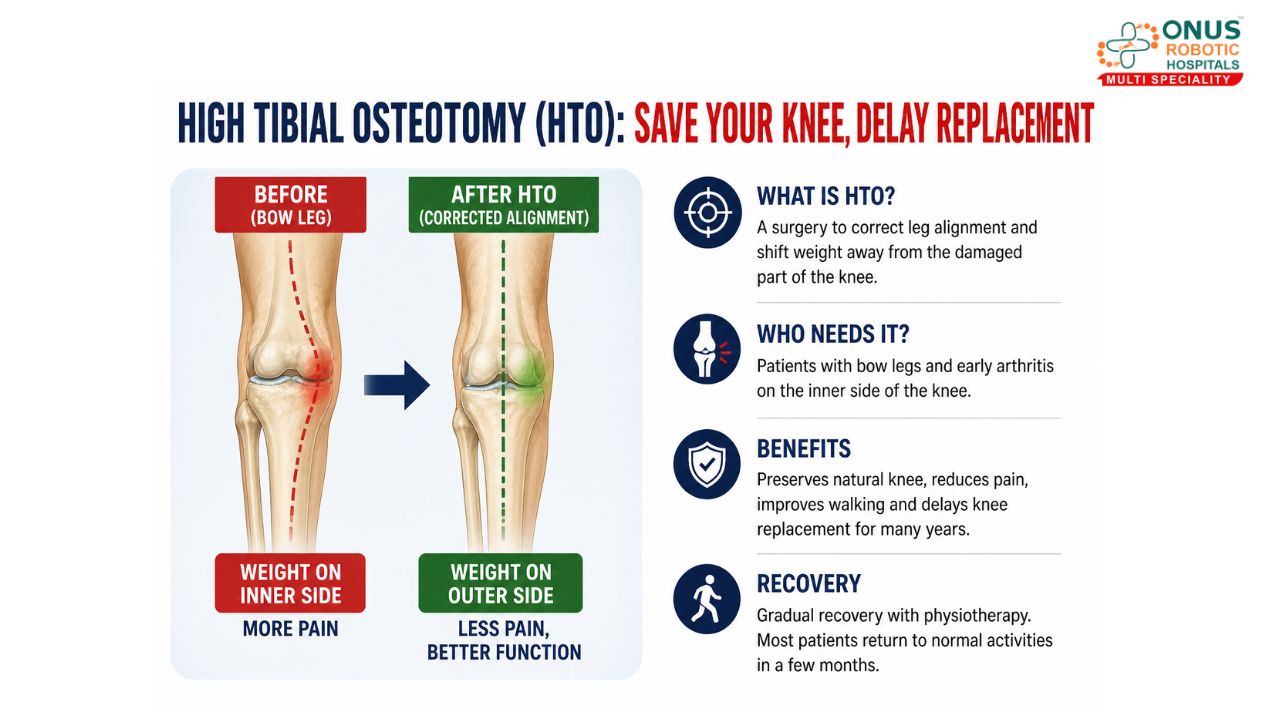
High Tibial Osteotomy (HTO): Save Your Knee, Delay Replacement- By Dr. Balaraju Naidu, Robotic Orthopedic Surgeon, ONUS Robotic Hospitals
A Joint Preservation Surgery for Bow Legs & Early Knee Arthritis
Are you experiencing inner-side knee pain, bow legs, or difficulty walking, but want to avoid early knee replacement? You may be a candidate for High Tibial Osteotomy.
At ONUS Robotic Hospitals, specialists like Dr. Balaraju Naidu perform HTO to correct alignment, reduce pain, and preserve your natural knee—especially in younger, active patients with early arthritis.
Key idea:
Correct the alignment → Shift the load → Protect the damaged cartilage → Delay knee replacement
What Is High Tibial Osteotomy (HTO)?
HTO is a bone realignment surgery done on the upper part of the shin bone (tibia).
- In bow legs (varus deformity), most body weight passes through the inner (medial) side of the knee.
- This accelerates cartilage wear and leads to Knee Osteoarthritis.
👉 HTO re-aligns the leg, shifting weight to the healthier outer side, reducing stress on the damaged area.
Who Is the Right Candidate for HTO?
HTO is not for everyone—it’s ideal for selected patients.
Best Candidates
- Age typically < 60 years (biological age matters)
- Active lifestyle (want to continue sports/work)
- Pain mainly on inner side of knee
- Early to moderate arthritis (not advanced)
- Bow-leg deformity present
- Good knee movement (not very stiff)
👉 If arthritis is advanced in the whole knee, knee replacement may be a better option.
Symptoms Where HTO May Help
You may benefit from HTO if you have:
- Inner-side knee pain
- Bow legs (legs curving outward)
- Pain while walking or climbing stairs
- Difficulty standing for long periods
- Early-stage knee arthritis
- Desire to delay or avoid knee replacement
How Bow Legs Lead to Knee Damage
In a normal leg, weight is evenly distributed.
In bow legs:
- Load shifts to the medial (inner) compartment
- Cartilage wears faster
- Pain increases over time
👉 HTO restores the mechanical axis, balancing load across the knee.
How Is HTO Surgery Done?
HTO is a precise orthopedic procedure.
Basic Steps
- A small cut is made in the upper tibia
- Bone is carefully opened or closed (wedge technique)
- Alignment is corrected
- A plate and screws are used to fix the bone
Techniques
- Open wedge osteotomy
- Closed wedge osteotomy
Modern planning ensures accurate correction.
Benefits of HTO Over Early Knee Replacement
HTO is a joint preservation surgery—not a replacement.
Key Advantages
- Preserves your natural knee
- Corrects deformity
- Reduces pain
- Improves walking ability
- Maintains activity level
- Delays knee replacement by many years
- Better for younger patients
👉 You keep your own joint longer.