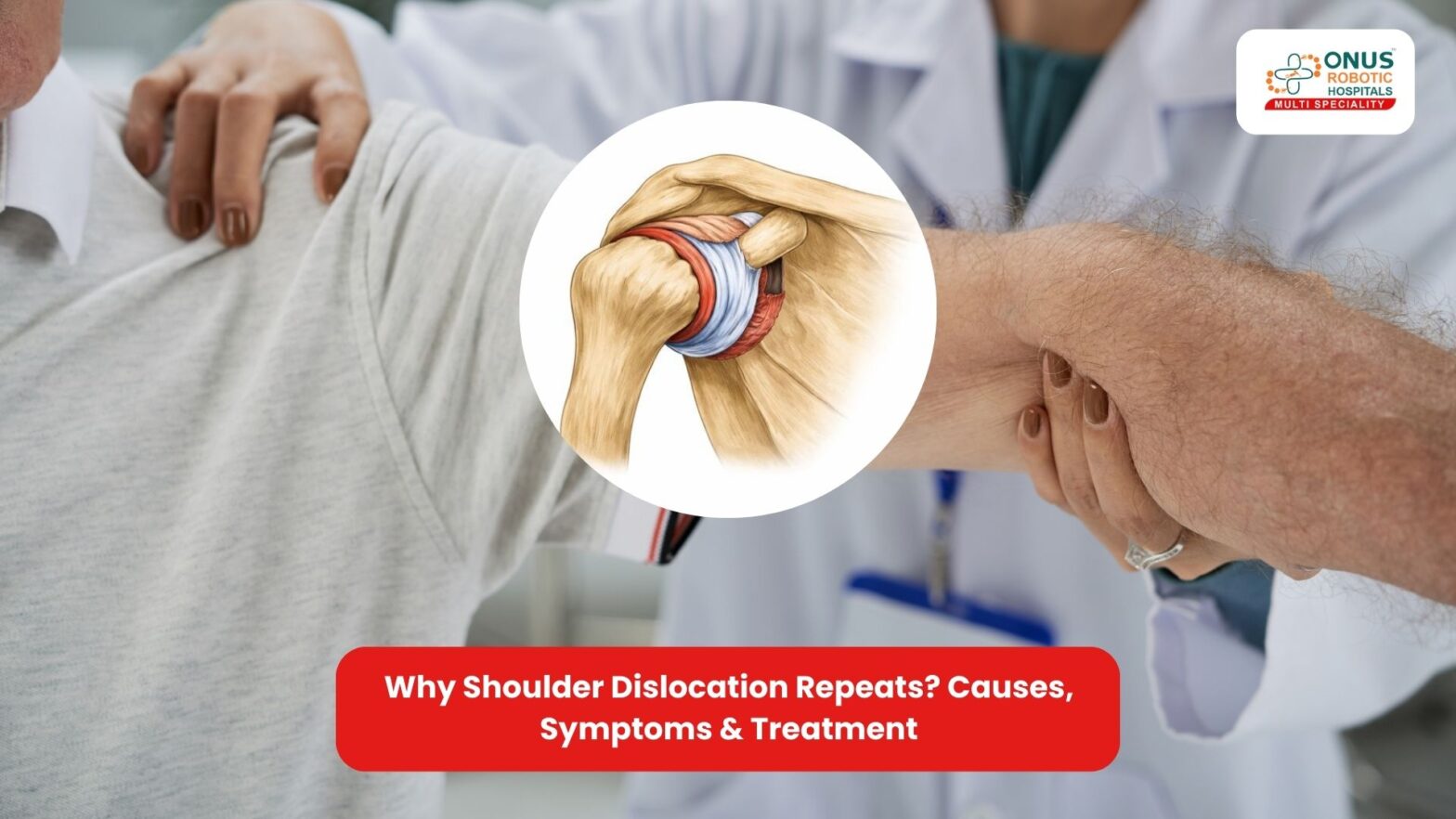
Why Shoulder Dislocation Repeats? Causes, Symptoms & Treatment: By Dr. Balaraju Naidu, Robotic Orthopedic Surgeon, ONUS Robotic Hospitals
Shoulder dislocation is one of the most common orthopedic emergencies. It not only causes severe pain but also makes the shoulder unstable. The big worry for most patients is this — “Will it happen again?”
Unfortunately, the answer is often YES. Shoulder dislocation has one of the highest recurrence rates in the body.
🔍 Why Does Shoulder Dislocation Happen Repeatedly?
1. Labrum Tear (Bankart Lesion)
The labrum is a soft cartilage ring around the socket. It deepens the socket and keeps the ball in place.
During the first dislocation, this labrum often gets torn, permanently reducing stability.
Once torn, the shoulder becomes “slippery,” making repeat dislocations more likely.
2. Loose Capsule
The shoulder capsule is a thick tissue envelope around the joint.
When the shoulder is dislocated, the capsule stretches abnormally.
A loose capsule = unstable shoulder = repeat dislocation even during day-to-day movements.
3. Weak Shoulder Muscles
Rotator cuff and scapular muscles stabilize the joint.
After injury, these muscles weaken due to pain and reduced activity.
Weak muscles fail to protect the shoulder from slipping out.
4. Age Factor
Young people, especially between 15–25 years, have very high recurrence rates.
Physical activity, sports participation, and flexibility make the joint more prone.
5. Bony Defects
- Hill-Sachs lesion (dent on humeral head)
- Glenoid bone loss
These reduce the contact area between the joint surfaces, increasing instability.
🤕 Symptoms of Recurrent Shoulder Instability
- Feeling of shoulder “slipping out”
- Pain during overhead activities
- Weakness in lifting weights
- Clicking or catching
- Fear of moving arm in certain angles (apprehension)
🩺 Diagnosis
Your doctor may recommend:
- X-ray
- MRI or MR Arthrogram
- CT scan for bone loss analysis
💉 Treatment Options
Non-Surgical Treatment
Useful for mild instability:
- Physiotherapy
- Rotator cuff strengthening
- Scapular control exercises
- Avoiding high-risk sports temporarily
Surgical Treatment
Recommended in young patients or repeated dislocations.
Common procedures:
- Arthroscopic Bankart Repair – fixes torn labrum
- Remplissage – for Hill-Sachs
- Latarjet Surgery – for bone loss
🏥 When to See a Doctor?
If you’ve had more than one shoulder dislocation, it’s a sign of structural damage. Early treatment can prevent arthritis and long-term weakness.
For Appointments:
ONUS Robotic Hospitals – Hyderabad