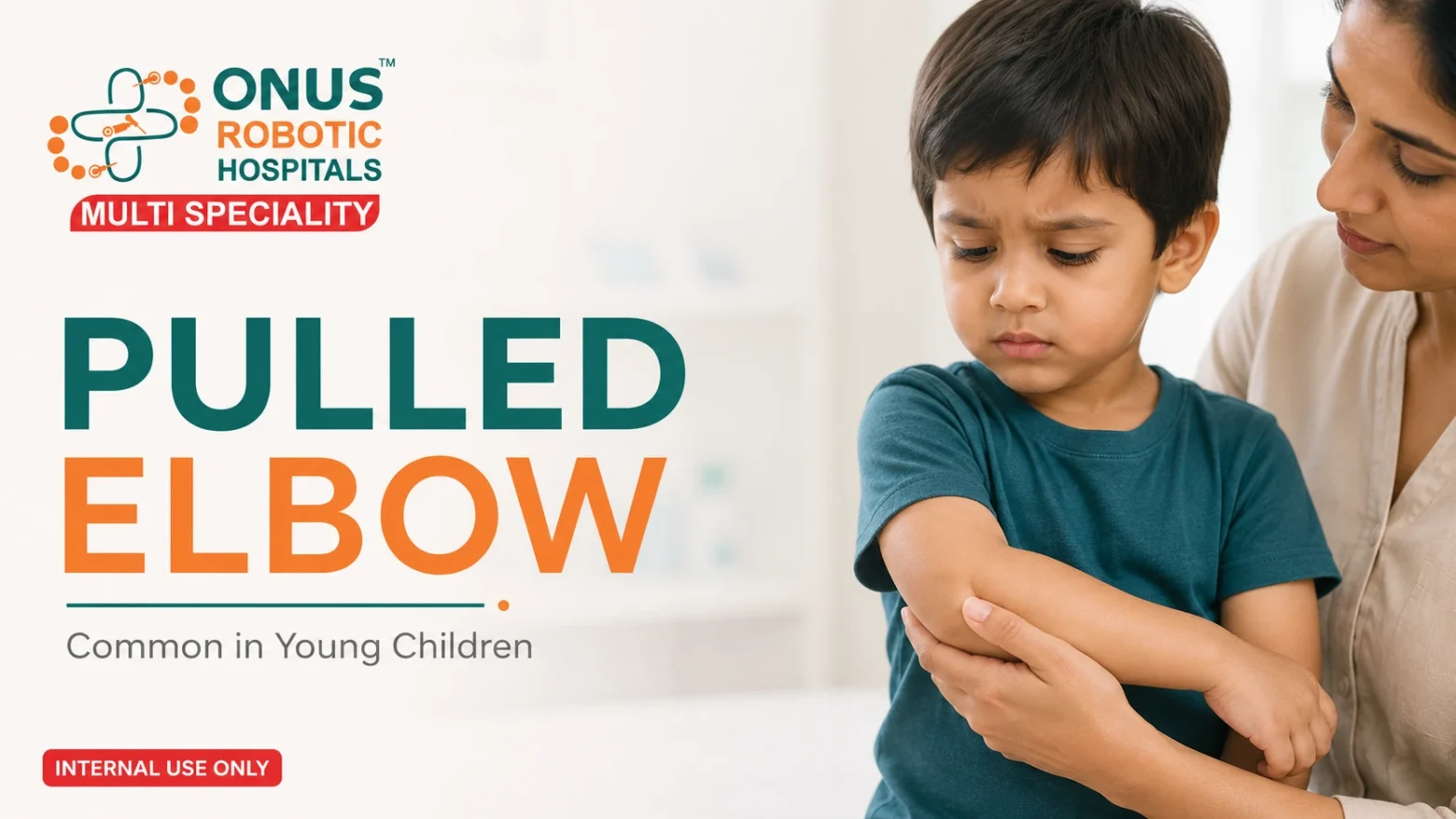
Pulled elbow is a common elbow injury seen in young children. It is also known as Nursemaid’s Elbow or radial head subluxation. Though it may look frightening for parents, it is usually treatable when diagnosed early and managed properly by a trained doctor.
Pulled elbow often happens when a child’s hand, wrist, or forearm is suddenly pulled. After the injury, the child may cry, refuse to move the arm, or keep the arm close to the body. Parents may think it is a fracture or a serious injury, but in many cases it is a partial slipping of a small bone near the elbow joint.
However, any child who suddenly stops using the hand after a pull, fall, or injury should be evaluated by a doctor to rule out fracture or other injury.
What Is Pulled Elbow?
Pulled elbow occurs when the radial head, a small bone near the elbow joint, partially slips out of its normal position. This is called radial head subluxation.
In young children, the ligaments around the elbow are still developing and are relatively loose. Because of this, even a sudden pull on the arm can cause the radial head to slip slightly from its position.
This condition is most commonly seen in children between 1 and 5 years of age.
Common Causes of Pulled Elbow
Pulled elbow usually happens due to a sudden pulling force on the child’s arm.
Common situations include:
- Pulling a child by the hand or wrist
- Lifting a child by one arm
- Swinging a child by the arms
- Pulling the child suddenly while walking
- Child suddenly pulling away while holding the parent’s hand
- Pulling the arm while dressing
- Rolling over the arm during play or sleep
- Sudden jerk to the forearm
Even a simple playful action can sometimes cause pulled elbow in young children.
Symptoms of Pulled Elbow
The symptoms usually appear immediately after the pulling incident.
Common symptoms include:
- Sudden crying after the arm is pulled
- Child refuses to use the affected arm
- Child keeps the arm close to the body
- Pain around the elbow or forearm
- Difficulty bending the elbow
- Difficulty rotating the forearm
- Child avoids lifting objects
- Child may not allow the arm to be touched
- Usually no major swelling
- Usually no visible deformity
In many cases, the child may look comfortable when the arm is not moved, but cries when someone tries to move it.
Why Parents Should Not Ignore It
Pulled elbow should not be ignored because the child may continue to avoid using the arm until it is treated.
Also, not every arm injury is pulled elbow. Sometimes a fracture, sprain, ligament injury, or elbow dislocation may look similar in the early stage.
Medical evaluation is especially important if:
- There is swelling around the elbow
- There is visible deformity
- The child had a fall
- The child has severe pain
- The child is not moving the arm
- There is bruising
- The child does not improve after treatment
- The injury happened due to major trauma
Parents should not try forceful manipulation at home. Reduction should be done only by a trained medical professional.
Diagnosis of Pulled Elbow
Diagnosis is usually made through history and clinical examination.
The doctor may ask:
- How the injury happened
- Whether the arm was pulled
- When the child stopped using the arm
- Whether there was a fall or direct injury
- Whether swelling or bruising is present
In typical pulled elbow, X-ray may not always be required. However, if there is swelling, deformity, severe pain, fall history, or doubt about fracture, an X-ray may be advised.
Treatment for Pulled Elbow
Pulled elbow is commonly treated with a simple medical procedure called reduction. During reduction, the doctor gently moves the child’s forearm and elbow to guide the radial head back into its normal position.
This procedure is usually quick, but it must be done carefully by a trained doctor.
After successful reduction, many children start using the arm again within a short time. Some children may take longer, especially if the injury has been present for several hours.
What Happens After Treatment?
After treatment, the child is usually observed for arm movement.
The doctor may ask the child to:
- Reach for a toy
- Lift the arm
- Bend the elbow
- Use the hand normally
If the child starts using the arm comfortably, further treatment may not be needed in many cases.
If the child still refuses to move the arm, or if pain continues, further evaluation such as X-ray may be required.
Can Pulled Elbow Happen Again?
Yes. Pulled elbow can happen again, especially in young children whose ligaments are still loose.
Parents and caregivers should be careful while holding, lifting, or playing with children.
Prevention Tips for Parents
To reduce the risk of pulled elbow:
- Do not pull a child suddenly by the hand or wrist
- Do not lift a child by one arm
- Do not swing children by holding their hands
- Lift the child by supporting under the arms
- Be careful while dressing the child
- Avoid sudden jerks while walking with the child
- Teach caregivers and family members about this injury
Small changes in handling can prevent repeated elbow injury.
When to Visit an Orthopedic Doctor Immediately
Visit an orthopedic doctor or emergency department if:
- Your child suddenly stops using the arm
- The child cries after the arm is pulled
- There is elbow pain after a fall
- The arm looks swollen or deformed
- The child has severe pain
- The child is unable to bend or straighten the arm
- The child is not improving after initial care
- The injury is repeated
Early treatment helps the child return to normal arm movement quickly.
Why Choose ONUS Robotic Hospitals?
At ONUS Robotic Hospitals, children and adults receive advanced orthopedic evaluation for elbow pain, trauma, fractures, sports injuries, and joint-related problems.
Dr. Balaraju Naidu and the orthopedic team provide accurate diagnosis and appropriate treatment for pulled elbow, pediatric elbow injuries, trauma care, and advanced orthopedic conditions.
For Appointments:
Dr. Balaraju Naidu, Robotic Orthopedic Surgeon
ONUS Robotic Hospitals – Hyderabad
👉 link: contact-us or book-appointment