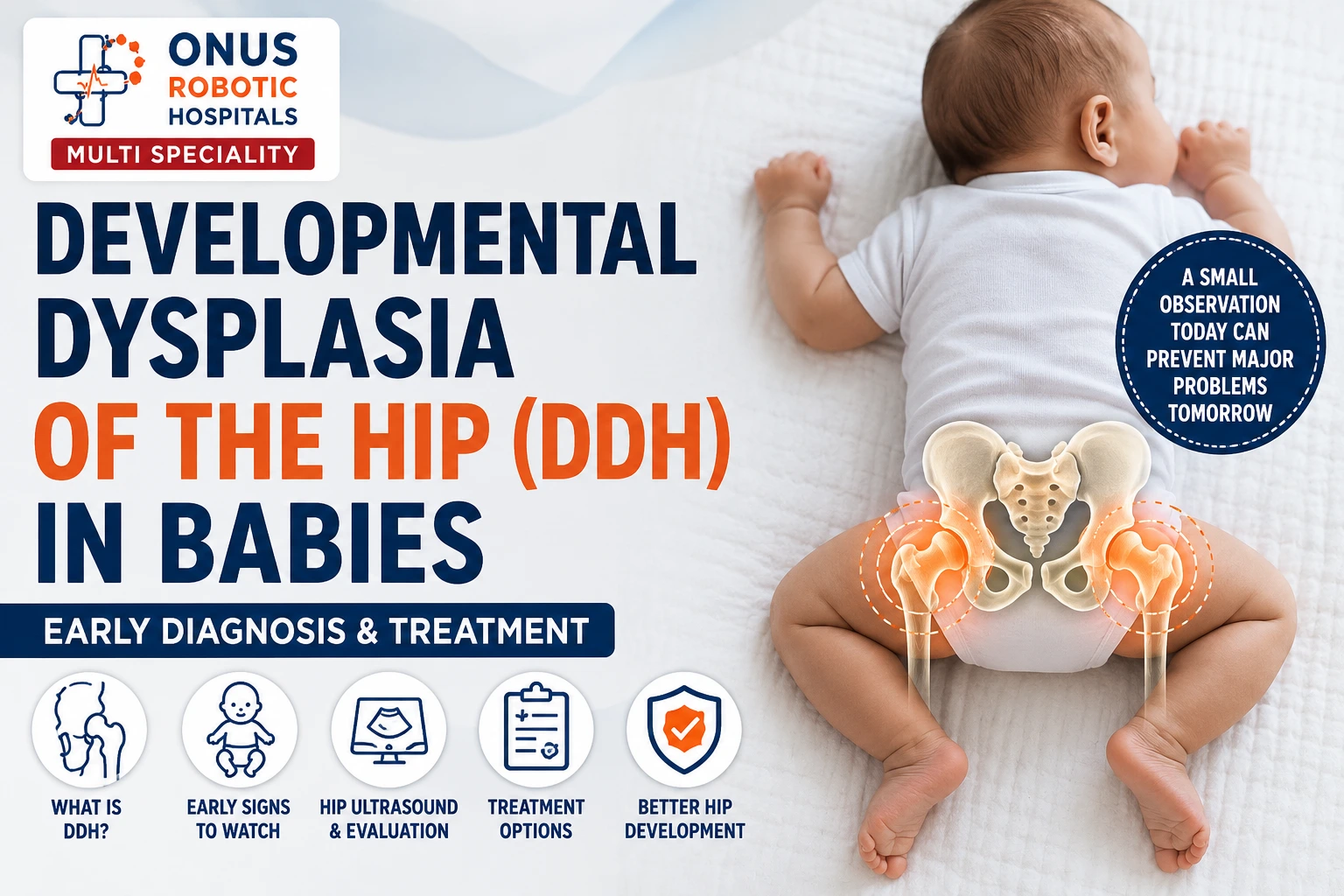
A baby’s first few months are crucial for healthy growth and development. During this period, the hip joint continues to mature and become more stable. In some infants, however, the hip joint does not develop properly, leading to a condition known as Developmental Dysplasia of the Hip (DDH).
If left untreated, DDH can affect a child’s ability to crawl, stand, walk, and participate in normal physical activities later in life. The good news is that early diagnosis and timely treatment can lead to excellent outcomes, allowing most children to develop healthy hip joints.
In this article, Dr. M. Balaraju Naidu, Robotic Orthopedic Surgeon at ONUS Robotic Hospitals, explains what DDH is, its symptoms, risk factors, diagnosis, treatment options, and why every parent should be aware of this condition.
What is Developmental Dysplasia of the Hip (DDH)?
Developmental Dysplasia of the Hip (DDH) is a condition in which the hip joint does not develop normally.
Normally, the rounded head of the thigh bone (femoral head) fits securely into the hip socket. In babies with DDH:
- The hip socket may be shallow.
- The femoral head may move loosely inside the socket.
- In severe cases, the hip may become partially or completely dislocated.
DDH can affect one or both hips, though the left hip is more commonly involved.
How Does the Hip Joint Normally Develop?
The hip is a ball-and-socket joint.
- The ball is the head of the femur (thigh bone).
- The socket is part of the pelvic bone.
During infancy, the hip joint is still developing. Proper positioning of the femoral head within the socket helps the socket grow into its normal shape.
If the hip is unstable or dislocated, normal development is affected.
Causes and Risk Factors
The exact cause of DDH is not always known, but certain factors increase the risk.
Common risk factors include:
- Family history of DDH
- First-born babies
- Female babies
- Breech presentation during pregnancy
- Low amniotic fluid levels
- Multiple pregnancies (twins or triplets)
- Tight swaddling with legs kept straight
Having one or more risk factors does not necessarily mean a baby will develop DDH, but careful screening is recommended.
Early Signs Parents Should Watch For
DDH may not always cause pain in babies, making it difficult to recognize without proper examination.
Parents should look for:
- Uneven skin folds on the thighs or buttocks
- One leg appearing shorter than the other
- Difficulty spreading one leg during diaper changes
- Limited hip movement
- Clicking or popping sensation during hip movement
- Uneven leg positioning
As children begin walking, untreated DDH may lead to:
- Limping
- Walking on toes on one side
- Waddling gait
- Difficulty running
- Hip pain later in childhood
Why Early Diagnosis Is Important
Early diagnosis offers the best chance for successful treatment.
When DDH is detected during the first few months of life:
- Treatment is usually simpler.
- Surgery can often be avoided.
- The hip develops more normally.
- Long-term complications are reduced.
- Walking and physical development improve.
Delaying treatment increases the likelihood of more complex procedures later.
How Is DDH Diagnosed?
Orthopedic specialists diagnose DDH through:
Physical Examination
Doctors assess:
- Hip stability
- Range of movement
- Leg length
- Hip symmetry
Certain gentle clinical tests help identify unstable hips during infancy.
Hip Ultrasound
For babies younger than six months, hip ultrasound is the preferred imaging method.
Ultrasound:
- Detects abnormal hip development early
- Is painless
- Does not use radiation
- Helps monitor treatment progress
X-ray
After approximately six months of age, X-rays may be used because the hip bones become more visible.
Treatment Options for DDH
Treatment depends on:
- Baby’s age
- Severity of DDH
- Hip stability
- Imaging findings
Pavlik Harness
For young infants, a Pavlik harness is commonly used.
This soft brace:
- Holds the hips in the correct position
- Encourages normal hip development
- Is usually worn continuously for several weeks under medical supervision
Early use often produces excellent results.
Closed Reduction and Hip Cast
If the hip remains dislocated or is diagnosed later, doctors may perform a closed reduction under anesthesia, followed by a hip spica cast.
Surgery
Older children or severe cases may require surgery to:
- Reposition the hip
- Improve the shape of the hip socket
- Restore normal hip stability
Surgical treatment depends on the child’s age and the severity of the condition.
What Happens If DDH Is Left Untreated?
Untreated DDH may result in:
- Abnormal walking pattern
- Hip pain
- Limping
- Limited movement
- Leg length difference
- Early arthritis
- Hip instability
- Need for complex surgery in adulthood
Early treatment greatly reduces these risks.
Can DDH Be Prevented?
Although DDH cannot always be prevented, parents can reduce risk by:
- Avoiding tight swaddling with legs held straight
- Allowing babies to keep hips naturally bent and apart
- Attending routine pediatric check-ups
- Following recommended newborn screening
- Seeking evaluation if any hip abnormality is suspected
When Should Parents Consult an Orthopedic Specialist?
Seek medical advice if you notice:
- Uneven thigh or buttock folds
- One leg shorter than the other
- Difficulty moving one leg
- Hip clicking
- Limited hip movement
- Delayed walking
- Limping after the child begins walking
Early evaluation provides the best opportunity for successful treatment.
Expert Pediatric Orthopedic Care at ONUS Robotic Hospitals
At ONUS Robotic Hospitals, children with Developmental Dysplasia of the Hip receive comprehensive evaluation using modern diagnostic techniques, including hip ultrasound and orthopedic assessment.
Dr. M. Balaraju Naidu provides individualized treatment plans based on each child’s age and the severity of the condition, ensuring the best possible outcomes for healthy hip development.
Remember:
A small observation today can prevent major problems tomorrow.
About the Doctor
Dr. M. Balaraju Naidu
Founder & Managing Director
Chief Robotic Orthopedic Surgeon
ONUS Robotic Hospitals
Dr. M. Balaraju Naidu specializes in pediatric orthopedic disorders, robotic joint replacement, trauma care, sports injuries, spine disorders, and advanced orthopedic surgery. He emphasizes early diagnosis and evidence-based treatment to help patients of all ages achieve better mobility and long-term musculoskeletal health.
Frequently Asked Questions (FAQs)
What is Developmental Dysplasia of the Hip (DDH)?
DDH is a condition in which a baby’s hip joint does not develop normally, causing instability or dislocation of the hip.
Can DDH be detected at birth?
Yes. Many cases can be identified during newborn examinations or through early hip ultrasound, especially in babies with risk factors.
Is DDH painful for babies?
Most infants with DDH do not experience pain, which is why routine screening and parental observation are important.
What is the best treatment for DDH?
Treatment depends on the baby’s age and severity. Options include a Pavlik harness, hip casting, or surgery in more advanced cases.
Why is early diagnosis important?
Early diagnosis allows simpler treatment, promotes normal hip development, and reduces the risk of long-term complications such as limping, arthritis, and hip instability.
For Appointments:
Dr. Balaraju Naidu, Robotic Orthopedic Surgeon
ONUS Robotic Hospitals – Hyderabad
👉 link: contact-us or book-appointment